After pondering Ben's mom's comment below, and my own annoyance, I have come up with a simple solution. Here it is, all you people who ever have occasion to make small talk with the parents of a baby or toddler. Instead of asking whether they have passed this or that developmental milestone, potentially annoying parents of a child who is taking his own time in some area, why not ask: "What does Baby like to do the best?"
Every baby, no matter how small, has preferences. The parents will be thrilled to talk about them. You might get a cute story out of the deal. You might have to listen to more than you want to, I suppose, but that's part of the perils of civilized conversation. Especially with new parents.
Tuesday, August 30, 2005


Animal Magnetism
The obsession with ducks and quacking has progressed to an interest in other animals and other sounds. D1 has a set of animal magnets which she plays with on the fridge. At first they were all "quack, quack," but now the sheep is starting to baa and the lion is starting to roar. I don't know what noise to give her for the turtle.
Even more fun are her stuffed duck and lamb, which she generally plays with on our bed. They will often take turns in lengthy conversations. "Quack, quack." "Baaaaaa." "Quack, quack." "Baaaa." Sometimes the sheep says quack or the duck says baaaa, but I guess they're bilingual.
Last night we initiated a new drama with the following plotline. Sheep, duck, or both, discover themselves fallen into the deep valley. The sheep baas pitifully, while the duck takes a more pragmatic approach. After some commiserating, they climb back up to the top of the mountain where they quack and baa triumphantly. This was repeated several times, to enthusiastic encores.
Why do people making conversation about babies always ask the same questions? From birth to about 8 months, it's "Are they sleeping through the night yet?" After that, it's "Are they walking yet?" Why doesn't anyone ever ask me if D1 can identify animals by their sounds or if she has an appreciation for drama?
Even more fun are her stuffed duck and lamb, which she generally plays with on our bed. They will often take turns in lengthy conversations. "Quack, quack." "Baaaaaa." "Quack, quack." "Baaaa." Sometimes the sheep says quack or the duck says baaaa, but I guess they're bilingual.
Last night we initiated a new drama with the following plotline. Sheep, duck, or both, discover themselves fallen into the deep valley. The sheep baas pitifully, while the duck takes a more pragmatic approach. After some commiserating, they climb back up to the top of the mountain where they quack and baa triumphantly. This was repeated several times, to enthusiastic encores.
Why do people making conversation about babies always ask the same questions? From birth to about 8 months, it's "Are they sleeping through the night yet?" After that, it's "Are they walking yet?" Why doesn't anyone ever ask me if D1 can identify animals by their sounds or if she has an appreciation for drama?
Monday, August 29, 2005
Fighting parents
I have on occasion heard of someone commenting that it is good for parents to fight in front of their children, so that the children will be prepared to fight properly in their own marriages without freaking out that something is wrong with them if they fight. On the other hand, I have more often heard that parents should never fight in front of their children, in order to present a united front.
Then there is the Miss Manners view, which is that you should fight in front of them, but in a foreign language, to increase the educational value.
I'm a bit skeptical of the former view, but can't quite put my finger on what is wrong with it. I would think it would be pretty hard for a husband and wife to fight publicly in a way that showed proper reverence and love, but I suppose it's not theoretically impossible.
We do expect to frequently disagree in front of our children, on such matters as public policy or literary interpretation, and indeed to encourage them to stake out their own positions as well. However, I suspect this is not what is meant.
Naturally we don't want to omit an important part of our children's education. But it would be difficult. First, we'd have to find something to fight about. Then we would have to want to fight. (I'm a middle child. I don't fight, I manipulate.) And if we had to do a foreign language, too--I suppose pig latin doesn't count. Perhaps our children will just have to miss out.
Then there is the Miss Manners view, which is that you should fight in front of them, but in a foreign language, to increase the educational value.
I'm a bit skeptical of the former view, but can't quite put my finger on what is wrong with it. I would think it would be pretty hard for a husband and wife to fight publicly in a way that showed proper reverence and love, but I suppose it's not theoretically impossible.
We do expect to frequently disagree in front of our children, on such matters as public policy or literary interpretation, and indeed to encourage them to stake out their own positions as well. However, I suspect this is not what is meant.
Naturally we don't want to omit an important part of our children's education. But it would be difficult. First, we'd have to find something to fight about. Then we would have to want to fight. (I'm a middle child. I don't fight, I manipulate.) And if we had to do a foreign language, too--I suppose pig latin doesn't count. Perhaps our children will just have to miss out.
Thursday, August 25, 2005
End of summer
Yesterday school started. Kindergarteners with brand-new backpacks marched down the sidewalks with both parents in tow. Moms were lining their kids up against the fence for the first-day-of-school-picture.
And yellow buses everywhere. I need to change my morning routes.
School supply sales are hard to resist. I limited myself to crayons for D1's Christmas and a few essentials I needed in the office.
The first shock of leaves on the sweet gum tree has changed color.
It's been below ninety for several days now. Sunny and dry. I can live with this.
Is it possible to eat too much of fresh tomatoes and sweet corn? I consider, then refill the salt shaker and decide against it.
I'm really starting to crave apples. Of course, it's hard to complain when peaches are still 77 cents a pound.
And yellow buses everywhere. I need to change my morning routes.
School supply sales are hard to resist. I limited myself to crayons for D1's Christmas and a few essentials I needed in the office.
The first shock of leaves on the sweet gum tree has changed color.
It's been below ninety for several days now. Sunny and dry. I can live with this.
Is it possible to eat too much of fresh tomatoes and sweet corn? I consider, then refill the salt shaker and decide against it.
I'm really starting to crave apples. Of course, it's hard to complain when peaches are still 77 cents a pound.
What to do with dry beans
Adult version:
Soak in water overnight.
Cook on low for several hours.
Season and serve.
Toddler version:
Pick them up.
Put them in the film canister.
Dump them out of the film canister.
Put them on the chair.
Put them in your mouth.
Find out Mama doesn't like them in your mouth. Protest.
Put them in the egg carton.
Throw them on the floor.
Ooops, Mama doesn't like that either. Drop them on the floor.
Drop them in the cardboard tube.
Drop them down the little holes in the box.
Pour them all over the floor.
Wallow in them.
Stick them between your toes.
Pick them up? Why?
Soak in water overnight.
Cook on low for several hours.
Season and serve.
Toddler version:
Pick them up.
Put them in the film canister.
Dump them out of the film canister.
Put them on the chair.
Put them in your mouth.
Find out Mama doesn't like them in your mouth. Protest.
Put them in the egg carton.
Throw them on the floor.
Ooops, Mama doesn't like that either. Drop them on the floor.
Drop them in the cardboard tube.
Drop them down the little holes in the box.
Pour them all over the floor.
Wallow in them.
Stick them between your toes.
Pick them up? Why?
Wednesday, August 24, 2005
By the book . . . whichever one that is
Every once in a while I will stumble across another this-baby-management-book vs. that-baby-management-book argument. And they all can cite statistics and studies and personal examples about how this book works and that book doesn't. But hardly ever do they seem to get the point.
Every baby is different. Every mom is different. Some moms freak out every time their child cries and need to be reassured that they aren't going to be warped for life because they had to wait a couple of minutes. Some moms think life can be scheduled to the minute for the next five years and need to learn to relax and go with the flow a little more. Some moms (like me) have their heads so lost in the clouds they need a lot of routine or they draw a blank as to what, exactly, might be a good idea to try next. (Diaper change? She needs a diaper change? Oh, yeah, it has been five hours, hasn't it?)
Some babies need to eat every two hours around the clock for months. On the other hand, I met one mother who had one baby (out of eight) sleep for 10 hours a night starting at birth. I'm sure no one would advocate that as a standard for any other baby, but he survived just fine. Some moms have to nurse frequently or they lose their milk supply. Some moms have milk for years after weaning. Some moms really need uninterrupted sleep at night. Some are going to have it more interrupted by not nursing than by nursing.
Not that books can't have good ideas, and some have more good ideas than others. I like my mother-in-law's standard advice: "Look at all the books. Then look at your baby." If you're putting books above your baby's health or long-term happiness, then you have a problem. Otherwise, why worry?
If someone reports that they and their baby are happy under Plan Y, why do some people feel a need to go around telling them Plan Y is evil and dangerous?
Every baby is different. Every mom is different. Some moms freak out every time their child cries and need to be reassured that they aren't going to be warped for life because they had to wait a couple of minutes. Some moms think life can be scheduled to the minute for the next five years and need to learn to relax and go with the flow a little more. Some moms (like me) have their heads so lost in the clouds they need a lot of routine or they draw a blank as to what, exactly, might be a good idea to try next. (Diaper change? She needs a diaper change? Oh, yeah, it has been five hours, hasn't it?)
Some babies need to eat every two hours around the clock for months. On the other hand, I met one mother who had one baby (out of eight) sleep for 10 hours a night starting at birth. I'm sure no one would advocate that as a standard for any other baby, but he survived just fine. Some moms have to nurse frequently or they lose their milk supply. Some moms have milk for years after weaning. Some moms really need uninterrupted sleep at night. Some are going to have it more interrupted by not nursing than by nursing.
Not that books can't have good ideas, and some have more good ideas than others. I like my mother-in-law's standard advice: "Look at all the books. Then look at your baby." If you're putting books above your baby's health or long-term happiness, then you have a problem. Otherwise, why worry?
If someone reports that they and their baby are happy under Plan Y, why do some people feel a need to go around telling them Plan Y is evil and dangerous?
Monday, August 22, 2005
Taking steps
So here it is, D1's 14-month birthday, and she's still not walking. Not even taking tentative steps. And I've had enough.
It's not that I'm concerned about her suffering from some sort of delay, or not keeping up with Little Johnny. I don't fear it reflects on her intelligence or future life or my ability as a mother.
No, my motive, if equally selfish, is at least less sinister. My back hurts. I can't carry two babies all the time. Since I have no choice on the one, the other one is going to have to learn the fine art of self-transportation.
It's not as if she's far off from walking. She can stand quite steadily and let herself down when she's done. She can walk with only one hand on the wall. She only crawls as a means to get to the other wall or piece of furniture. She can virtually run if she has some fingers to hold on to. She just doesn't want to let go yet.
That's fine. (The stories tell that DOB could only walk at first when he was carrying a chair around with him.) But I'm not going to enable her anymore. When we go down the hallway, she can push her walker or hold onto the wall or my finger or crawl. I'm not carrying her.
Barring the usual possible interruptions, we have plans this week to go visit her friend Chase, who is a very mobile little fellow. It was only a few days after visiting him last time that she decided to sit up for the first time and get serious about crawling. So maybe seeing him run around will give her the idea that this, too, is a possibility for people her size.
It's not that I'm concerned about her suffering from some sort of delay, or not keeping up with Little Johnny. I don't fear it reflects on her intelligence or future life or my ability as a mother.
No, my motive, if equally selfish, is at least less sinister. My back hurts. I can't carry two babies all the time. Since I have no choice on the one, the other one is going to have to learn the fine art of self-transportation.
It's not as if she's far off from walking. She can stand quite steadily and let herself down when she's done. She can walk with only one hand on the wall. She only crawls as a means to get to the other wall or piece of furniture. She can virtually run if she has some fingers to hold on to. She just doesn't want to let go yet.
That's fine. (The stories tell that DOB could only walk at first when he was carrying a chair around with him.) But I'm not going to enable her anymore. When we go down the hallway, she can push her walker or hold onto the wall or my finger or crawl. I'm not carrying her.
Barring the usual possible interruptions, we have plans this week to go visit her friend Chase, who is a very mobile little fellow. It was only a few days after visiting him last time that she decided to sit up for the first time and get serious about crawling. So maybe seeing him run around will give her the idea that this, too, is a possibility for people her size.
Friday, August 19, 2005
Technology has gone too far
Today I answered the phone.
"Hello?"
First there was an electronically charged silence, then a recorded woman's voice came on and said, "I'm sorry!" Then silence again.
The only thing I can conclude is that it was an automated wrong number dialer.
"Hello?"
First there was an electronically charged silence, then a recorded woman's voice came on and said, "I'm sorry!" Then silence again.
The only thing I can conclude is that it was an automated wrong number dialer.
Police Blotter
I had forgotten how much fun the local police blotter can be to read. Here's a sampling from yesterday. I thought it would be improved by a few subheads.
Trying for a free bath?
An officer was flagged down and told a naked man was near the dog kennels by the Mason Car Wash. Officers checked the area, but no naked men were seen.
And I can talk with the animals!
A Tuesday evening report of a suspicious person sent officers out to the Lowe's Drive area. A man was found who told police he was just playing with raccoons.
Those out-of-towners hit too hard
An East Ruby Avenue woman reported 1:05 pm she was assaulted on A Street by a non-local woman.
Trying for a free bath?
An officer was flagged down and told a naked man was near the dog kennels by the Mason Car Wash. Officers checked the area, but no naked men were seen.
And I can talk with the animals!
A Tuesday evening report of a suspicious person sent officers out to the Lowe's Drive area. A man was found who told police he was just playing with raccoons.
Those out-of-towners hit too hard
An East Ruby Avenue woman reported 1:05 pm she was assaulted on A Street by a non-local woman.
Thursday, August 18, 2005
The importance of unimportant things
At this stage in the pregnancy, the two most important activities are eating and going to the bathroom. Both are remarkably difficult with a 14-month-old clinging to one's legs. I'm starting to pray that D1 will learn to walk soon.
The eating had really been a problem on Tuesday, and by evening I was really, really craving lemon poke cake (that's where you poke holes in a yellow cake and pour lemonade over the top). But it was late, I was exhausted, we were out of ingredients, my kitchen appliances have all migrated back into the dining room, and making one was out of the question. Besides, we didn't need lemon poke cake. So I tried, not too successfully, to dismiss the thought from my mind.
But yesterday, even though it was shopping day and everything went nearly wrong, and D1 took an extra short nap, I decided I had had it. We didn't need a lemon poke cake, but I was going to make one anyway!
At the end of the day, it was late, I was exhausted, my back hurt, and my kitchen appliances were still scattered all over the dining room. But we had lemon poke cake. And I felt much better about life.
Maybe today I'll cut out that jumper I've been wanting to make for D1.
The eating had really been a problem on Tuesday, and by evening I was really, really craving lemon poke cake (that's where you poke holes in a yellow cake and pour lemonade over the top). But it was late, I was exhausted, we were out of ingredients, my kitchen appliances have all migrated back into the dining room, and making one was out of the question. Besides, we didn't need lemon poke cake. So I tried, not too successfully, to dismiss the thought from my mind.
But yesterday, even though it was shopping day and everything went nearly wrong, and D1 took an extra short nap, I decided I had had it. We didn't need a lemon poke cake, but I was going to make one anyway!
At the end of the day, it was late, I was exhausted, my back hurt, and my kitchen appliances were still scattered all over the dining room. But we had lemon poke cake. And I felt much better about life.
Maybe today I'll cut out that jumper I've been wanting to make for D1.
Tuesday, August 16, 2005
The waters come over my soul
Sunday night as DOB was putting D1 down to bed, he commented, "Her shirt is kind of wet."
I didn't worry about it. Her shirt is always kind of wet, between drool and learning to use a cup. And it's August, so it seems more likely that it will contribute to coolness than to pneumonia.
But a few hours later she started bawling in her sleep. I went in to check on her and discovered that her shirt was soaked--front and back. I changed her and she settled right back down. I still can't figure out how she got the back of her shirt wet.
The next morning I was trying to rouse DOB. He's pretty incoherent until he's had a glass of water, so I sat him up and was holding his glass up to his mouth, trying to get him to drink it. Unfortunately, I overestimated the angle needed and misunderstood his hyperventilation. The next thing I knew the water had dumped over his t-shirt. Within a fraction of a second, he had ripped the shirt off and thrown it at my fleeing figure with deadly aim. You would hardly believe he had been sound asleep a few moments before.
The moral of the story, I suppose, is that wet shirts are good for waking people up, but bad for the person responsible.
I didn't worry about it. Her shirt is always kind of wet, between drool and learning to use a cup. And it's August, so it seems more likely that it will contribute to coolness than to pneumonia.
But a few hours later she started bawling in her sleep. I went in to check on her and discovered that her shirt was soaked--front and back. I changed her and she settled right back down. I still can't figure out how she got the back of her shirt wet.
The next morning I was trying to rouse DOB. He's pretty incoherent until he's had a glass of water, so I sat him up and was holding his glass up to his mouth, trying to get him to drink it. Unfortunately, I overestimated the angle needed and misunderstood his hyperventilation. The next thing I knew the water had dumped over his t-shirt. Within a fraction of a second, he had ripped the shirt off and thrown it at my fleeing figure with deadly aim. You would hardly believe he had been sound asleep a few moments before.
The moral of the story, I suppose, is that wet shirts are good for waking people up, but bad for the person responsible.
Monday, August 15, 2005
Up?

How could you resist this plea? Even if it has just been repeated for the fifteenth time, interspersed with "Up?" (which, if already up, means "Down?") She worked out this sign on her own, at the same time as she learned to say the word, which is her usual habit. The sign is so cute that DOB will often try to coax it out of her even if she's said the word in plain English half a dozen times.
Before the horse gets stolen
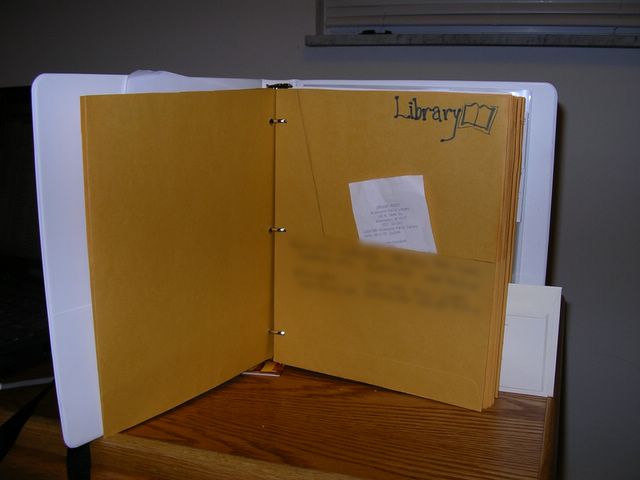
One night during dinner last week, I started chattering away to DOB about the new household organizing notebook I wanted to make. It would have pockets for each month, to store invitations and appointment cards and far-in-advance-bills and things like that, and ones for more urgent stuff, and one for the library receipts so that we wouldn't lose track of when they had to be returned.
"So," he asked apprehensively, "What prompted this?"
"I was reading on somebody's blog about one."
"Oh. Good. I was afraid this was a prelude to telling me we had a big library fine."
But no, all the books got returned on time and now we have a place to keep track of them. Plus I finally have a personal phone book besides in DOB's head.
Thursday, August 11, 2005
It never fails
I thought we'd settled down to a routine where D1 was sleeping well until about 8, then ready to be up until 11 or noon, have an early lunch, and take one afternoon nap. And I needed that this morning, because I have a doctor's appointment at 11.
It's 7:15, and she's been chattering in there for half an hour. By the time we leave for the doctor's, no doubt she'll be exhausted. And the last time she went to the doctor's office, they gave her a shot and a blood test, so I'm not sure she'll be too thrilled to see them anyway.
It's 7:15, and she's been chattering in there for half an hour. By the time we leave for the doctor's, no doubt she'll be exhausted. And the last time she went to the doctor's office, they gave her a shot and a blood test, so I'm not sure she'll be too thrilled to see them anyway.
Wednesday, August 10, 2005
Some (slightly) radical thoughts on math
I wouldn't be surprised if most or all of my kids hate reading. After all, I always hated reading in school. I'm still lousy at it, and I don't do it unless I have to. But I guess everybody has to learn to read, so they'll have to do an hour or so of reading worksheets every day while they're in school. They'll hate it, and probably forget most of it, but what else can we do?
You don't believe that paragraph, of course. Indeed, you wouldn't believe anyone even moderately well-educated would say such things. But substitute "math" for "reading" and it doesn't sound nearly so odd, does it? We seem to expect that except for the favored few math whizzes, destined to be scientists, engineers, or actuaries, everyone else will merely suffer through math, finding it dull, confusing, and forgettable.
I don't think it should be that way--or that it has to be that way. Nobody thinks that only future authors and literary critics can learn to enjoy reading, or learn to write well enough to compose their own love letters and shopping lists. Math is the language that the universe speaks, a tool necessary for survival, and a source of beauty and pleasure. It ought to be available to everyone.
If the trouble isn't in the subject, then it must be in the teaching. Nobody expects to raise good readers by years of rehearsing phonetic charts alone. There is a time and a place for phonics instruction--at least for many children--but you learn what reading is by time with books, real books that tell you things you want to know. Unfortunately, most children's contact with math has no connection to reality; to the extent it does, it is tacked on arbitrarily at the end, through those dreaded story problems about things they care nothing about.
All the math usually taught in the first eight years of school is easily contained in a book that one could work through in the course of a year. They just repeat the same thing, a little more complexly, every year. And review, review, review.
Nobody needs to review their phonics charts once they can read fluently. Similarly, endless review of math facts once learned is only needed if you're not actually using math. If they aren't going to use the math, why teach it to them? And if they are using it, why waste their time?
Most elementary math books concentrate on drilling in computation skills. But that's not the primary need in math. The most important thing is to be able to think about a problem and figure out how to solve it. If you can do that, you can always work out the computational details on your own. If you can't, the fastest time on your multiplication worksheets won't help you.
What if instead of trudging through all those years of math books, children spent most of those seven years dealing with math first in reality, using it to find out things they wanted to know, exploring math games and puzzles, watching how adults used math in real life, and spending a comparatively small amount of time learning how to express those ideas--once they fully owned them--in symbols?
I suspect they'd come through much more thoroughly grounded in mathematics than those who had gone through the best traditional course in mathematics. If they had missed something (and I think with some preparation and challenges that would be unlikely), they would still have a year to sit down with a good comprehensive overview of arithmetic and pick up what they'd missed before starting into higher math on the normal schedule. In the meantime, they would have learned the why of math, and they would not have learned to hate it.
You don't believe that paragraph, of course. Indeed, you wouldn't believe anyone even moderately well-educated would say such things. But substitute "math" for "reading" and it doesn't sound nearly so odd, does it? We seem to expect that except for the favored few math whizzes, destined to be scientists, engineers, or actuaries, everyone else will merely suffer through math, finding it dull, confusing, and forgettable.
I don't think it should be that way--or that it has to be that way. Nobody thinks that only future authors and literary critics can learn to enjoy reading, or learn to write well enough to compose their own love letters and shopping lists. Math is the language that the universe speaks, a tool necessary for survival, and a source of beauty and pleasure. It ought to be available to everyone.
If the trouble isn't in the subject, then it must be in the teaching. Nobody expects to raise good readers by years of rehearsing phonetic charts alone. There is a time and a place for phonics instruction--at least for many children--but you learn what reading is by time with books, real books that tell you things you want to know. Unfortunately, most children's contact with math has no connection to reality; to the extent it does, it is tacked on arbitrarily at the end, through those dreaded story problems about things they care nothing about.
All the math usually taught in the first eight years of school is easily contained in a book that one could work through in the course of a year. They just repeat the same thing, a little more complexly, every year. And review, review, review.
Nobody needs to review their phonics charts once they can read fluently. Similarly, endless review of math facts once learned is only needed if you're not actually using math. If they aren't going to use the math, why teach it to them? And if they are using it, why waste their time?
Most elementary math books concentrate on drilling in computation skills. But that's not the primary need in math. The most important thing is to be able to think about a problem and figure out how to solve it. If you can do that, you can always work out the computational details on your own. If you can't, the fastest time on your multiplication worksheets won't help you.
What if instead of trudging through all those years of math books, children spent most of those seven years dealing with math first in reality, using it to find out things they wanted to know, exploring math games and puzzles, watching how adults used math in real life, and spending a comparatively small amount of time learning how to express those ideas--once they fully owned them--in symbols?
I suspect they'd come through much more thoroughly grounded in mathematics than those who had gone through the best traditional course in mathematics. If they had missed something (and I think with some preparation and challenges that would be unlikely), they would still have a year to sit down with a good comprehensive overview of arithmetic and pick up what they'd missed before starting into higher math on the normal schedule. In the meantime, they would have learned the why of math, and they would not have learned to hate it.
Tuesday, August 09, 2005
Baby's First Field Trip
Yesterday we visited the National Museum of the United States Air Force with His & Her Majesty. It is the ideal museum: it's within an hour of home (for us), it's really cool, and it's free. (Except for the IMAX, but I never heard of anywhere that let you see the IMAX for free.) Under such circumstances, we didn't feel too bad that we only wound up with a couple of hours to go through it, especially after waiting for them to have a motorized cart available, so we had to take it in at warp speed.
This was the first time we tried anything of the sort with D1--and she even preceded it by consuming her first real restaurant meal under her own steam, though she did let me order for her. They didn't have toddler-sized silverware either. We were glad someone else was going to clean up the floor after she was done.
She seemed to enjoy it surprisingly well, even the IMAX movie. For whatever reason she doesn't startle at sudden noises, and she got very excited and would start flapping her arms whenever she saw birds on the screen. She wasn't as impressed with the airplanes, though. She napped most of the way through the exhibit hall.
I must be transforming into "mother" role pretty seriously. I go to a cool museum and all I can remember to talk about is how the kids handled it. Having gotten over the hump of trying it once, though, I'm more optimistic about actually learning something next time.
Also, next time we're taking a picnic and making a day of it.
Oh, and although I remembered the camera, I forgot to check if the batteries were charged. So no pictures. I'm going to have to get better than this before we need school records.
This was the first time we tried anything of the sort with D1--and she even preceded it by consuming her first real restaurant meal under her own steam, though she did let me order for her. They didn't have toddler-sized silverware either. We were glad someone else was going to clean up the floor after she was done.
She seemed to enjoy it surprisingly well, even the IMAX movie. For whatever reason she doesn't startle at sudden noises, and she got very excited and would start flapping her arms whenever she saw birds on the screen. She wasn't as impressed with the airplanes, though. She napped most of the way through the exhibit hall.
I must be transforming into "mother" role pretty seriously. I go to a cool museum and all I can remember to talk about is how the kids handled it. Having gotten over the hump of trying it once, though, I'm more optimistic about actually learning something next time.
Also, next time we're taking a picnic and making a day of it.
Oh, and although I remembered the camera, I forgot to check if the batteries were charged. So no pictures. I'm going to have to get better than this before we need school records.
Friday, August 05, 2005
A non-mushy post
It seems to be the time of year for mushy posts, for anniversaries and first meetings.
I could post something mushy, I suppose. After all, this week it's been three years since DOB and I first met in person. Roughly five years since we met online and started making plans for our first debate. And ten years (gak! Am I that old?) since I started law school, without which I would never have met him.
But I have had enough mush. My tolerance level for public mushiness has not increased any over the last ten years. My tolerance level for private mushiness is none of your business.
And so in public, I will just send a simple, heartfelt message to DOB:
I still say you cheated on that debate.
There.
I could post something mushy, I suppose. After all, this week it's been three years since DOB and I first met in person. Roughly five years since we met online and started making plans for our first debate. And ten years (gak! Am I that old?) since I started law school, without which I would never have met him.
But I have had enough mush. My tolerance level for public mushiness has not increased any over the last ten years. My tolerance level for private mushiness is none of your business.
And so in public, I will just send a simple, heartfelt message to DOB:
I still say you cheated on that debate.
There.
Thursday, August 04, 2005
Science Experiments Gone Awry
This is not a post about recent cooking mishaps. Rather, it is a post about an experience which is probably now at least two decades old. It dates back to a summer day when I decided, in capital letters, that I was going to Conduct a Science Experiment.
The subject of my experiment needed to be something readily at hand. Dandelions were available in plenty. What would happen to dandelions, I wondered, if they were placed in different substances? Next, a substance to test. Again something was available: mud. So I plucked a handful of dandelions, put them in a bowlful of mud, and went to bed anxiously awaiting the morning and the results of my Experiment.
The next morning I arose betimes and went out in the early dew to see how my subjects had fared. Behold, they were all closed up! Clearly, mud caused dandelions to close their blossoms. Trembling with my new discovery, I immediately went off to exhibit my results to some older and wiser person.
This older and wiser person (I can't remember now who it was) promptly pointed out that all the dandelions visible in the fields in all directions had their blossoms closed at that hour of the morning. Oh. It suddenly also occurred to me that mud was, in fact, exactly what dandelions grew in. My Experiment was a complete, and somewhat embarrassing, failure. I had learned nothing from it.
Now that I think about it though, I probably learned more from that one very silly experiment than I could have from the most cleverly designed science course. I learned, in fact even if the terms came later, the necessity of careful design, of observation, of control groups, of peer review. I learned not to jump to conclusions or confuse correllation with causation. We did many fun and worthy experiments in later years, but I have forgotten nearly all of them. But the dandelions are still there every time I read about a new discovery or claim, helping me to ask the right questions.
And I still do wonder why some flowers close up at night. One of these days, I'm going to get around to finding out. Maybe it's the dark . . . ;-)
The subject of my experiment needed to be something readily at hand. Dandelions were available in plenty. What would happen to dandelions, I wondered, if they were placed in different substances? Next, a substance to test. Again something was available: mud. So I plucked a handful of dandelions, put them in a bowlful of mud, and went to bed anxiously awaiting the morning and the results of my Experiment.
The next morning I arose betimes and went out in the early dew to see how my subjects had fared. Behold, they were all closed up! Clearly, mud caused dandelions to close their blossoms. Trembling with my new discovery, I immediately went off to exhibit my results to some older and wiser person.
This older and wiser person (I can't remember now who it was) promptly pointed out that all the dandelions visible in the fields in all directions had their blossoms closed at that hour of the morning. Oh. It suddenly also occurred to me that mud was, in fact, exactly what dandelions grew in. My Experiment was a complete, and somewhat embarrassing, failure. I had learned nothing from it.
Now that I think about it though, I probably learned more from that one very silly experiment than I could have from the most cleverly designed science course. I learned, in fact even if the terms came later, the necessity of careful design, of observation, of control groups, of peer review. I learned not to jump to conclusions or confuse correllation with causation. We did many fun and worthy experiments in later years, but I have forgotten nearly all of them. But the dandelions are still there every time I read about a new discovery or claim, helping me to ask the right questions.
And I still do wonder why some flowers close up at night. One of these days, I'm going to get around to finding out. Maybe it's the dark . . . ;-)
Wednesday, August 03, 2005
Why we don't order pizza
The kitchen had been torn up for three weeks. I had exhausted my supply of easy meals to cook. We were feeling sick. The cupboard was essentially bare of groceries because the next day was shopping day.
Still, we scarcely had the nerve to consider the option. To understand how difficult this was for us, you would either have to be raised in a family where all food had to be organic and prepared from scratch, or in a family where all food had to be purchased at least fifty percent off. We had ordered pizza for meetings, yes, but just for us?
Anyway, it was dinner time and I was hungry. I tried to rouse DOB enough to ask him how I should proceed. Any pizza coupons we had ever had around were long since vanished. He suggested I look online. So I pulled up the websites of all the different chains and compared available coupons and menu options. Very bewildering, and hard to get DOB's feedback on what he wanted as he was still asleep.
I finally had a rough idea of what was available. The likely cheapest option was the kind of pizza we didn't like. Several had no prices on their website. DOB didn't think one could get the best deal that way anyway. So he arose, got out the phonebook and called all the pizza delivery places in town, asking them about potential prices (after pleading our desparate case), delivery times ("the kids are hungry"--never mind that neither of them can eat pizza), and crust options. He tracked all of these on a notepad. We also managed to negotiate a topping compromise.
By this time we were really, really hungry. Also we were out of water (our distiller quit some time ago). So DOB decided he would cut half an hour off the delivery time by going and picking up the pizza himself, while getting water. Only he got stuck in traffic coming home, so it may not have saved any time. And he forgot to ask for thin crust. Still, it was good and we were fed.
On the whole, though, I think it's easier just to cook. I suppose it would be much easier if we were in the habit of ordering out, but $14 just for dinner? Yeeouch.
Still, we scarcely had the nerve to consider the option. To understand how difficult this was for us, you would either have to be raised in a family where all food had to be organic and prepared from scratch, or in a family where all food had to be purchased at least fifty percent off. We had ordered pizza for meetings, yes, but just for us?
Anyway, it was dinner time and I was hungry. I tried to rouse DOB enough to ask him how I should proceed. Any pizza coupons we had ever had around were long since vanished. He suggested I look online. So I pulled up the websites of all the different chains and compared available coupons and menu options. Very bewildering, and hard to get DOB's feedback on what he wanted as he was still asleep.
I finally had a rough idea of what was available. The likely cheapest option was the kind of pizza we didn't like. Several had no prices on their website. DOB didn't think one could get the best deal that way anyway. So he arose, got out the phonebook and called all the pizza delivery places in town, asking them about potential prices (after pleading our desparate case), delivery times ("the kids are hungry"--never mind that neither of them can eat pizza), and crust options. He tracked all of these on a notepad. We also managed to negotiate a topping compromise.
By this time we were really, really hungry. Also we were out of water (our distiller quit some time ago). So DOB decided he would cut half an hour off the delivery time by going and picking up the pizza himself, while getting water. Only he got stuck in traffic coming home, so it may not have saved any time. And he forgot to ask for thin crust. Still, it was good and we were fed.
On the whole, though, I think it's easier just to cook. I suppose it would be much easier if we were in the habit of ordering out, but $14 just for dinner? Yeeouch.
Tuesday, August 02, 2005
Naming Ideas Rejected
We revived the question of baby names recently, and came up with some new options:
The favorite authors sequence: We could name our first son John Ronald, which would be both for DOB and for Tolkien. Then we could have Gilbert Keith for Chesterton and Clives Staples . . . never mind.
The all-sons-named-for-dad-sequence: In alphabetical order, too! AaRON, ByRON, CameRON, DaRON (so I've never seen it spelled that way, but it looks cool). I got stuck at E, though, so we would max out at four sons. Unless we went with ElRONd.
The rhyming-alphabetical sequence: DOB countered with the suggestion that we name them Addison (Ad), Brad, Chad, and then he, of course, would be Dad. It sounds like the makings of a bluegrass band. Plus, that only gets us up to three.
The favorite authors sequence: We could name our first son John Ronald, which would be both for DOB and for Tolkien. Then we could have Gilbert Keith for Chesterton and Clives Staples . . . never mind.
The all-sons-named-for-dad-sequence: In alphabetical order, too! AaRON, ByRON, CameRON, DaRON (so I've never seen it spelled that way, but it looks cool). I got stuck at E, though, so we would max out at four sons. Unless we went with ElRONd.
The rhyming-alphabetical sequence: DOB countered with the suggestion that we name them Addison (Ad), Brad, Chad, and then he, of course, would be Dad. It sounds like the makings of a bluegrass band. Plus, that only gets us up to three.
Gaming Question
Last night I was pondering why I am usually significantly less enthusiastic about playing games than DOB is. Then I started listing off the games we usually play:
Games which are a toss-up
Cribbage
Scrabble (I know more words, but DOB will spend more time hunting for the top score)
Lawn Horseshoes
Games which DOB almost always wins
Rummy
Tetris
Games which DOB ALWAYS wins
Computer golf
Chess (except for an occasional stalemate, which is always pure accident on my part)
Monopoly (And I can't figure out why, because as far as I can tell our strategies are the same)
Games which QOC usually or always wins
None
This is a discouraging picture. What we need are some games that favor someone who is good with words but impatient with strategy, and of course that are fun for two players.
Games which are a toss-up
Cribbage
Scrabble (I know more words, but DOB will spend more time hunting for the top score)
Lawn Horseshoes
Games which DOB almost always wins
Rummy
Tetris
Games which DOB ALWAYS wins
Computer golf
Chess (except for an occasional stalemate, which is always pure accident on my part)
Monopoly (And I can't figure out why, because as far as I can tell our strategies are the same)
Games which QOC usually or always wins
None
This is a discouraging picture. What we need are some games that favor someone who is good with words but impatient with strategy, and of course that are fun for two players.
Monday, August 01, 2005
Milestones the Baby Books Miss: First Self-inflicted Bleeding
Before I get to that story, though, a little context might be good.
After living here for a year and a half, we are trying to get the bathroom and kitchen walls finished so we can actually put outlet covers and towel racks up. So B2 and B5 have been here nearly every morning (B2 works graveyard and comes by after work) mudding and sanding and keeping D1 fascinated with their pocket flashlights. Meanwhile, the kitchen and full bathroom are just barely usable, their contents are scattered throughout the house, and everything, including D1, is covered with a thick layer of drywall dust. But, it will be done soon! Or so I keep reminding myself.
Since we were hoping to start painting this week, B2 spent the day and well into the night on Saturday working on the kitchen. We went to bed and left him still working. At two in the morning, I heard a soft knock on the bedroom door, and the quiet announcement that B2 had come down sick. Very, very sick.
While I was still trying to figure out what to do about this, DOB, who can sleep through an hour of multiple alarm clocks and spousal abuse, had leaped out of bed, dressed, and gone out to deal with the problem. He took care of it all and drove B2 home. We got back to bed about 4:30, and DOB told me I was on my own with D1 in the morning, as he was sleeping in as long as possible.
In the morning D1 mercifully slept a little late, then I got her up and gave her breakfast. She played around in the dust and I cleaned up what mess was left from the night before, then started exercising. DOB was still sound asleep. D1 started pushing her walker down the hallway, when suddenly she slipped underneath it. I picked her up, reassured her, and set her back down, but she continued to wail. Then I looked down and saw blood spattered on her pajama top.
I quietly called for help. Instantly, DOB was on his feet, staggering down the hallway. When he realized what was wrong, he quickly woke up the rest of the way, assessed the situation (cut lip from her bottom tooth), instructed me on the creation of an ice pack, and called his mom for further advice. D1 didn't really go for an ice pack, nor for chunks of ice. We finally decided to try frozen nectarines, which she took very happily. But by that time the bleeding had stopped anyway, and she had been pretty calm as soon as she was sure we knew the seriousness of the situation.
Not surprisingly, we were a bit late for church. And we were looking forward to a relaxing afternoon at DOB's family's house. After lunch, I tried to put D1 down for her nap, when she suddenly started assuming weird positions and screaming. This not being her usual reaction, even when she doesn't want to take a nap, we began a check for something being wrong. Finally we decided it had to be stomach pain and we started to wonder how contagious B2 had been. She couldn't lie down comfortably, so I rocked her until she fell asleep and then held her there until she had such nap as she could.
She woke up still uncomfortable, but after another half-hour or so it seemed to subside, and she took water and snack and supper cheerfully enough. By the time we had gotten home and done with supper, DOB and I were both thoroughly exhausted, but she was as chipper as ever. We laid down to rest, trying to keep an eye on her, but in an unguarded moment she pulled the nightstand over on top of her.
Fortunately there was no damage. And fortunately by that time it was bedtime. This morning, DOB slept through the alarm for an hour. But then, so did I.
After living here for a year and a half, we are trying to get the bathroom and kitchen walls finished so we can actually put outlet covers and towel racks up. So B2 and B5 have been here nearly every morning (B2 works graveyard and comes by after work) mudding and sanding and keeping D1 fascinated with their pocket flashlights. Meanwhile, the kitchen and full bathroom are just barely usable, their contents are scattered throughout the house, and everything, including D1, is covered with a thick layer of drywall dust. But, it will be done soon! Or so I keep reminding myself.
Since we were hoping to start painting this week, B2 spent the day and well into the night on Saturday working on the kitchen. We went to bed and left him still working. At two in the morning, I heard a soft knock on the bedroom door, and the quiet announcement that B2 had come down sick. Very, very sick.
While I was still trying to figure out what to do about this, DOB, who can sleep through an hour of multiple alarm clocks and spousal abuse, had leaped out of bed, dressed, and gone out to deal with the problem. He took care of it all and drove B2 home. We got back to bed about 4:30, and DOB told me I was on my own with D1 in the morning, as he was sleeping in as long as possible.
In the morning D1 mercifully slept a little late, then I got her up and gave her breakfast. She played around in the dust and I cleaned up what mess was left from the night before, then started exercising. DOB was still sound asleep. D1 started pushing her walker down the hallway, when suddenly she slipped underneath it. I picked her up, reassured her, and set her back down, but she continued to wail. Then I looked down and saw blood spattered on her pajama top.
I quietly called for help. Instantly, DOB was on his feet, staggering down the hallway. When he realized what was wrong, he quickly woke up the rest of the way, assessed the situation (cut lip from her bottom tooth), instructed me on the creation of an ice pack, and called his mom for further advice. D1 didn't really go for an ice pack, nor for chunks of ice. We finally decided to try frozen nectarines, which she took very happily. But by that time the bleeding had stopped anyway, and she had been pretty calm as soon as she was sure we knew the seriousness of the situation.
Not surprisingly, we were a bit late for church. And we were looking forward to a relaxing afternoon at DOB's family's house. After lunch, I tried to put D1 down for her nap, when she suddenly started assuming weird positions and screaming. This not being her usual reaction, even when she doesn't want to take a nap, we began a check for something being wrong. Finally we decided it had to be stomach pain and we started to wonder how contagious B2 had been. She couldn't lie down comfortably, so I rocked her until she fell asleep and then held her there until she had such nap as she could.
She woke up still uncomfortable, but after another half-hour or so it seemed to subside, and she took water and snack and supper cheerfully enough. By the time we had gotten home and done with supper, DOB and I were both thoroughly exhausted, but she was as chipper as ever. We laid down to rest, trying to keep an eye on her, but in an unguarded moment she pulled the nightstand over on top of her.
Fortunately there was no damage. And fortunately by that time it was bedtime. This morning, DOB slept through the alarm for an hour. But then, so did I.
Friday, July 29, 2005
My Homeschooling Fantasy
This is, first of all, mine. Not how I think everyone should homeschool, but how I think we will enjoy homeschooling. (DOB thinks it sounds good, too, if I can pull it off.) Secondly, I realize it's a fantasy and thus subject to revision when it rubs up against reality. But this is how various homeschooling ideas are coalescing in my mind.
Our general structure will be a four-year survey of world history. DOB and I like studying and debating history ourselves. It has its own internal order. It's effortless to integrate it with language arts, geography, art and music, and not too hard to integrate it with science. And I found a really cool binder for our timeline at a yard sale last week.
Every four to six weeks we'll start on a new segment of history. Between now and then we'll find a well-written narrative world history to read aloud from and start a new segment, and for every segment I'll pick out a literary or biographical work that we'll enjoy reading out loud from together. Once we've read the history book to introduce the segment, I'll put up a big sheet of paper and we'll start writing down questions we have. They don't have to be about the time period we're studying, they can be about anything. And anybody in the family can come up with them. We might spend a couple of days on this.
Once we have a good sheet full of things we want to find out about, we'll start finding out what resources we have to answer those questions, and make a trip to the library and anywhere else that comes up to research them further. As much as possible, the children will be responsible for finding their own resources for the things they want to know.
Except for our introductory time first thing in the morning, when we recite some memory work together and read aloud, the children are free until lunch time to choose their own work. There will be, of course, a few expectations: they should be working on academic stuff in the morning (afternoons are free); they should keep track of what they do and for how long for records; and of course when they learn something new and exciting, they'll want to record it or share it in some way because that's the natural thing to do. We'll keep lots of different kinds of notebooks for recording the different things we learn.
Meanwhile I'll do my best not to hover or force my ideas on them, but be available to answer questions and talk things through, in between doing my own research or work that helps them see what use these skills have later. With the younger ones, I'll usually also spend a short time each day introducing them to a new are in a specific skill--as much as possible tied into what they are learning right now.
After about a week into a segment, when we've gotten a "feel" for what's out there, the children (with help, if needed and requested) will start selecting a few larger projects that they will want to present at our end-of-segment party. Maybe I will, too. This could be anything--from a poem to recite to a 3D demonstration of building a pyramid, and it could be individual or collective. Whatever captures their interest and gives them a chance to develop their perseverance and presentation skills is fair game. We'll continue working on these until the end of the segment, along with whatever short-term interests come up along the way.
At the end, we'll have a celebration, show off what we've learned, and look forward to starting something new.
Our general structure will be a four-year survey of world history. DOB and I like studying and debating history ourselves. It has its own internal order. It's effortless to integrate it with language arts, geography, art and music, and not too hard to integrate it with science. And I found a really cool binder for our timeline at a yard sale last week.
Every four to six weeks we'll start on a new segment of history. Between now and then we'll find a well-written narrative world history to read aloud from and start a new segment, and for every segment I'll pick out a literary or biographical work that we'll enjoy reading out loud from together. Once we've read the history book to introduce the segment, I'll put up a big sheet of paper and we'll start writing down questions we have. They don't have to be about the time period we're studying, they can be about anything. And anybody in the family can come up with them. We might spend a couple of days on this.
Once we have a good sheet full of things we want to find out about, we'll start finding out what resources we have to answer those questions, and make a trip to the library and anywhere else that comes up to research them further. As much as possible, the children will be responsible for finding their own resources for the things they want to know.
Except for our introductory time first thing in the morning, when we recite some memory work together and read aloud, the children are free until lunch time to choose their own work. There will be, of course, a few expectations: they should be working on academic stuff in the morning (afternoons are free); they should keep track of what they do and for how long for records; and of course when they learn something new and exciting, they'll want to record it or share it in some way because that's the natural thing to do. We'll keep lots of different kinds of notebooks for recording the different things we learn.
Meanwhile I'll do my best not to hover or force my ideas on them, but be available to answer questions and talk things through, in between doing my own research or work that helps them see what use these skills have later. With the younger ones, I'll usually also spend a short time each day introducing them to a new are in a specific skill--as much as possible tied into what they are learning right now.
After about a week into a segment, when we've gotten a "feel" for what's out there, the children (with help, if needed and requested) will start selecting a few larger projects that they will want to present at our end-of-segment party. Maybe I will, too. This could be anything--from a poem to recite to a 3D demonstration of building a pyramid, and it could be individual or collective. Whatever captures their interest and gives them a chance to develop their perseverance and presentation skills is fair game. We'll continue working on these until the end of the segment, along with whatever short-term interests come up along the way.
At the end, we'll have a celebration, show off what we've learned, and look forward to starting something new.
Thursday, July 28, 2005
At least we're compatible
DOB got this result, too . . . it still seems a little too New Agey, make-it-up-as-you-goish to me. But then, the statements for agreement or disagreement were unconstitutionally vague, in my opinion. You scored as Cultural Creative. Cultural Creatives are probably the newest group to enter this realm. You are a modern thinker who tends to shy away from organized religion but still feels as if there is something greater than ourselves. You are very spiritual, even if you are not religious. Life has a meaning outside of the rational.
What is Your World View? (updated) created with QuizFarm.com |
Wednesday, July 27, 2005
Monday, July 25, 2005
Adjusting Expectations
I find a lot of complaints in the how-to-be-a-good-Christian-homemaker writings about how our mothers failed to teach us this stuff, and hence we have great handicaps to overcome. Well, my mother didn't fail to teach me. I knew all the elements of homemaking pretty well by the time I was twelve, and for the most part I liked them, too. Even when I had a full-time job and lived away from home, I got a big charge out of coming home, fixing dinner for my roommates, and tidying up the place.
So naturally when I got married I expected the housekeeping part of it to all go smoothly. Early struggles were for those poor folks who didn't know how to cook or clean or mend clothes.
Then I encountered morning sickness, overdue bills, undersized apartments, and unpacked boxes. And I discovered that I knew about the wrong end of homemaking. I don't wonder about how mothers of nine do it. They have children who can clean the house and cook dinner while they produce number ten and organize the workload. It's how mothers of two and three little ones do it that mystifies me.
I know how to clean a house in no time flat--with one person to take out the garbages, one to sweep the floors, one to hide the junk, and one to clean the bathrooms. Piece of cake. I know how to cook a generous breakfast for ten people in half an hour--if I can impress someone into flipping the pancakes while I whip up the eggs. Attempting either of these tasks singlehandedly, while trying to supervise and train a toddler or two, is an entirely different matter.
Even without the workers factored in, it just takes time--and money--to get a house operating smoothly. I still don't have a complete set of pots and pans, which means I have to do circuitous things like cook the oatmeal in two pots. Many things already go a lot smoother than they did a year ago; but it took time to figure out where things should be and how they should be done.
I used to ask my mother, perhaps not in the best of spirits, how she did all this stuff before she had us to do it for her. Now I know. She didn't. And now I have to realize that I cannot possibly attempt single-handedly what it took four or more half or fully grown children plus two parents to accomplish. (Or at least attempt--as I recall, we were usually running behind despite our best endeavors.)
So it's OK if I don't have a two-acre garden, eight different dishes on the table for supper every night, company over twice a week, and several ministries going through home and church. For the next few years, if everyone is fed and reasonably happy at the end of the day, it's been a good day. If on top of that we've managed to wash enough dishes and laundry to be ready to face the next day, it's been a great day. If somebody has also learned something or accomplished something that won't have to be redone tomorrow, it's been an outstandingly wonderful day.
Someday we will get past this stage and be able to set our sights a little higher. But there's nothing wrong with the day of small things. And people.
So naturally when I got married I expected the housekeeping part of it to all go smoothly. Early struggles were for those poor folks who didn't know how to cook or clean or mend clothes.
Then I encountered morning sickness, overdue bills, undersized apartments, and unpacked boxes. And I discovered that I knew about the wrong end of homemaking. I don't wonder about how mothers of nine do it. They have children who can clean the house and cook dinner while they produce number ten and organize the workload. It's how mothers of two and three little ones do it that mystifies me.
I know how to clean a house in no time flat--with one person to take out the garbages, one to sweep the floors, one to hide the junk, and one to clean the bathrooms. Piece of cake. I know how to cook a generous breakfast for ten people in half an hour--if I can impress someone into flipping the pancakes while I whip up the eggs. Attempting either of these tasks singlehandedly, while trying to supervise and train a toddler or two, is an entirely different matter.
Even without the workers factored in, it just takes time--and money--to get a house operating smoothly. I still don't have a complete set of pots and pans, which means I have to do circuitous things like cook the oatmeal in two pots. Many things already go a lot smoother than they did a year ago; but it took time to figure out where things should be and how they should be done.
I used to ask my mother, perhaps not in the best of spirits, how she did all this stuff before she had us to do it for her. Now I know. She didn't. And now I have to realize that I cannot possibly attempt single-handedly what it took four or more half or fully grown children plus two parents to accomplish. (Or at least attempt--as I recall, we were usually running behind despite our best endeavors.)
So it's OK if I don't have a two-acre garden, eight different dishes on the table for supper every night, company over twice a week, and several ministries going through home and church. For the next few years, if everyone is fed and reasonably happy at the end of the day, it's been a good day. If on top of that we've managed to wash enough dishes and laundry to be ready to face the next day, it's been a great day. If somebody has also learned something or accomplished something that won't have to be redone tomorrow, it's been an outstandingly wonderful day.
Someday we will get past this stage and be able to set our sights a little higher. But there's nothing wrong with the day of small things. And people.
Assortment of thoughts related to doctors
* Our family doctor is leaving family practice. This is the doctor we were so excited to find because she worked five minutes away, didn't push for testing and drugs, was OK with a careful approach to vaccinations, did obstetrics too, and even had in-laws with DOB's genetic condition. But her insurance premiums have gotten too high, so she is going to go treat hemmorrhoids. A noble calling I'm sure, but not one we have much use for. I am limited in who I can blame for this situation, having loyalties in both the legal and insurance fields, but I'd put the blame on the lawyers. Doctors and insurance companies at least still face some free market constraints, though not enough, whereas lawsuits do not.
The one potentially hopeful news is that she might be joining her husband in family practice in a couple of years, where starting over will get her back to the beginning on insurance ratings. But he has a different name (which I can't remember) and practices in a town thirty minutes away, so I don't know how I'll find out when and if she does.
* Naptimes and doctor's appointments do not mix well. D1 is very good and very regular about taking her naps. But what the books cannot show you is that while in the book you can turn the page from the 9-month nap schedule to the 12-month schedule to the 18-month schedule, in real life the change is made incrementally. D1 is gradually moving from morning and afternoon nap to early afternoon nap. Which means that sometime in the next couple of months, 1:00 will become a very bad time for doctor's appointments, even though now it is the ideal time. Unfortunately doctors don't like to wait until that morning to find out how the naptime schedule is progressing and when you can most easily come in.
* I accidentally scheduled my next doctor's appointment on the day His Majesty is out visiting. Now I have to reschedule. Bother. Yes, of course I should have consulted my calendar first. The trouble is, I have yet to see an organizational scheme that would work for someone who can't follow a grocery list.
Besides, all these prenatal appointments annoy me. I go in and spend half an hour laughing at the advice in parenting magazines. Doctor comes in. "Are you having problems X, Y, and Z?" "Nope." "Everything looks fine." "Thanks." Baby's heart is still beating (as I was sure it was, being as it's hard to kick without a heartbeat), I am getting bigger (as I had noticed). All is well. I already knew that. And now I have to go do this every two weeks.
The one potentially hopeful news is that she might be joining her husband in family practice in a couple of years, where starting over will get her back to the beginning on insurance ratings. But he has a different name (which I can't remember) and practices in a town thirty minutes away, so I don't know how I'll find out when and if she does.
* Naptimes and doctor's appointments do not mix well. D1 is very good and very regular about taking her naps. But what the books cannot show you is that while in the book you can turn the page from the 9-month nap schedule to the 12-month schedule to the 18-month schedule, in real life the change is made incrementally. D1 is gradually moving from morning and afternoon nap to early afternoon nap. Which means that sometime in the next couple of months, 1:00 will become a very bad time for doctor's appointments, even though now it is the ideal time. Unfortunately doctors don't like to wait until that morning to find out how the naptime schedule is progressing and when you can most easily come in.
* I accidentally scheduled my next doctor's appointment on the day His Majesty is out visiting. Now I have to reschedule. Bother. Yes, of course I should have consulted my calendar first. The trouble is, I have yet to see an organizational scheme that would work for someone who can't follow a grocery list.
Besides, all these prenatal appointments annoy me. I go in and spend half an hour laughing at the advice in parenting magazines. Doctor comes in. "Are you having problems X, Y, and Z?" "Nope." "Everything looks fine." "Thanks." Baby's heart is still beating (as I was sure it was, being as it's hard to kick without a heartbeat), I am getting bigger (as I had noticed). All is well. I already knew that. And now I have to go do this every two weeks.
Friday, July 22, 2005
Culture and Counterculture
I've just finished a book called Kingdom of Children, by Mitchell L. Stevens. It's the work of a sociologist who spent a decade getting acquainted with the homeschool movement, looking at it not from the perspective of what happens to the children, but what happens to the parents. Why do they do this? How do they form social networks to support what they do? And how do their ideas fit in with society at large?
Interestingly, although most people (inside and outside) think of homeschooling as a radically countercultural thing to do, he concludes that homeschoolers primarily operate from an especially deep commitment to an idea that is omnipresent in our culture--the sanctity of the individual, not just the individual's rights, but his core identity and uniqueness. The centrality of guarding and developing your child's individuality pops up constantly not just in the group he terms the "inclusives," who tend to come out of liberal social causes, alternative schools, and to emphasize unschooling, but for "believers" as well--the conservative Protestants who make up the largest and most visible segment of homeschoolers.
Despite this common commitment, "believers" vs. "inclusives" are usually rigorously divided, and getting more so. He concludes, after watching the rift develop through the nineties, that this is primarily the result of comfort with different organizational structures. Inclusives stay true to the commitment to democracy and consensus they brought from the social movements of the 60's and 70's, which results in a very loosely-structured group; believers prefer a more hierarchical structure with definite leaders and roles, like they find in their churches and evangelical ministries. The latter being more efficient, the believers have been out building multi-million dollar enterprises while the inclusives are still trying to figure out a board meeting date that won't conflict with anyone's holidays.
The believers also have the advantage that mothers staying home is commonly encouraged in conservative Protestant circles, with the bonus that homeschooling gives them something intellectually challenging and significant to do while they're at home. Inclusives tend to have feminist backgrounds, which gives them much less of a natural base for justifying staying home with their kids.
Definitely an interesting read if one is curious about what the homeschooling movement looks like as a whole, from the outside, or just in how people's beliefs influence the structures and lives they create.
Interestingly, although most people (inside and outside) think of homeschooling as a radically countercultural thing to do, he concludes that homeschoolers primarily operate from an especially deep commitment to an idea that is omnipresent in our culture--the sanctity of the individual, not just the individual's rights, but his core identity and uniqueness. The centrality of guarding and developing your child's individuality pops up constantly not just in the group he terms the "inclusives," who tend to come out of liberal social causes, alternative schools, and to emphasize unschooling, but for "believers" as well--the conservative Protestants who make up the largest and most visible segment of homeschoolers.
Despite this common commitment, "believers" vs. "inclusives" are usually rigorously divided, and getting more so. He concludes, after watching the rift develop through the nineties, that this is primarily the result of comfort with different organizational structures. Inclusives stay true to the commitment to democracy and consensus they brought from the social movements of the 60's and 70's, which results in a very loosely-structured group; believers prefer a more hierarchical structure with definite leaders and roles, like they find in their churches and evangelical ministries. The latter being more efficient, the believers have been out building multi-million dollar enterprises while the inclusives are still trying to figure out a board meeting date that won't conflict with anyone's holidays.
The believers also have the advantage that mothers staying home is commonly encouraged in conservative Protestant circles, with the bonus that homeschooling gives them something intellectually challenging and significant to do while they're at home. Inclusives tend to have feminist backgrounds, which gives them much less of a natural base for justifying staying home with their kids.
Definitely an interesting read if one is curious about what the homeschooling movement looks like as a whole, from the outside, or just in how people's beliefs influence the structures and lives they create.
Wednesday, July 20, 2005
On Becoming a Lady of Leisure
It took DOB quite a while to convince me. It was too expensive, I argued. I shouldn't need it. I should be able to do everything myself now.
But he finally won. The downside of marrying a guy because he's smart enough to beat you at a debate is that he continues to do so.
Maybe it's because I argue against myself. I wouldn't feel like a failed housewife if my husband had the time and strength to help with the housework. Nor would I feel guilty for impressing my children into service. What made me feel guilty that, lacking those, I couldn't keep up with everything? And, like it or not, I was still struggling to catch up on things that had gotten behind during the first trimester and was making no headway whatsoever on preparing for the new baby--much less on tackling the moving-in projects that never got finished before D1 arrived. I had managed to suppress my guilt enough to accept DOB's sister's (free) help through the first trimester, but she had gone to Taiwan.
So we have now hired a young girl to come in twice a week and help me with the housework. It does cost a bit, but I could easily spend as much on disposable diapers and wipes plus a few convenience foods, which most people in my situation would use to lessen their workload. We could easily spend more if we instead hired her to babysit while we went out for an evening, which is commonly suggested as a beneficial if not essential activity for young mothers.
But right now, it means a lot more to both of us for me to be in good spirits and not too tired at the end of the day, with a new area of the house a little more organized than it was before, and the floors and bathrooms finally cleaned.
Never mind about that lady of leisure bit, either. Actually I work twice as hard with someone else around. I like working with people. That's why I've had little trouble keeping up with dishes and laundry since D1 got big enough to "help" with those. Her help with the floors and bathrooms is not such a good idea, however, and her help with organizing projects is definitely counter-productive.
I have to think of three solid hours of tasks to do. With two people handy, those tasks can include ones that may create large messes, because there's an extra person to keep D1 distracted. And I'm not as scared to tackle something big for fear of running out of energy when there's someone else around as backup.
So, there it is. I have help. I refuse to feel guilty about it. In fact, I really, really like it.
But he finally won. The downside of marrying a guy because he's smart enough to beat you at a debate is that he continues to do so.
Maybe it's because I argue against myself. I wouldn't feel like a failed housewife if my husband had the time and strength to help with the housework. Nor would I feel guilty for impressing my children into service. What made me feel guilty that, lacking those, I couldn't keep up with everything? And, like it or not, I was still struggling to catch up on things that had gotten behind during the first trimester and was making no headway whatsoever on preparing for the new baby--much less on tackling the moving-in projects that never got finished before D1 arrived. I had managed to suppress my guilt enough to accept DOB's sister's (free) help through the first trimester, but she had gone to Taiwan.
So we have now hired a young girl to come in twice a week and help me with the housework. It does cost a bit, but I could easily spend as much on disposable diapers and wipes plus a few convenience foods, which most people in my situation would use to lessen their workload. We could easily spend more if we instead hired her to babysit while we went out for an evening, which is commonly suggested as a beneficial if not essential activity for young mothers.
But right now, it means a lot more to both of us for me to be in good spirits and not too tired at the end of the day, with a new area of the house a little more organized than it was before, and the floors and bathrooms finally cleaned.
Never mind about that lady of leisure bit, either. Actually I work twice as hard with someone else around. I like working with people. That's why I've had little trouble keeping up with dishes and laundry since D1 got big enough to "help" with those. Her help with the floors and bathrooms is not such a good idea, however, and her help with organizing projects is definitely counter-productive.
I have to think of three solid hours of tasks to do. With two people handy, those tasks can include ones that may create large messes, because there's an extra person to keep D1 distracted. And I'm not as scared to tackle something big for fear of running out of energy when there's someone else around as backup.
So, there it is. I have help. I refuse to feel guilty about it. In fact, I really, really like it.
Tuesday, July 19, 2005
Sizing up women
Those of you who have had occasion to compare women's clothing over multiple decades (which, owing to a very extensive hand-me-down network, includes me) may have noticed that women's size numbers undergo a periodic shrinkage. What was a twelve or fourteen in the sixties is now an eight, rapidly moving to a six.
A svelte young Elizabeth Taylor in The Last Time I Saw Paris sighs in despair, "I'll never be a size 10 again." Had she known this propensity of fashion designers, she need not have worried so much. Perhaps that's why it's done--to allow us to remain the same size while gradually expanding our figures. (She may have outpaced them by now, though.)
I notice, however, that the descriptors "small," "medium," and "large" still describe roughly the same bodies they always did, no doubt due to the lack of an infinite sequence of words to keep moving down. One can only put so many x's in front of "small" before one runs out of room on the tag.
All this would be of small concern were it not that we're getting uncomfortably close to the bottom of positive numbers. Within the next three decades, this trend is either going to have to stop, or a significant portion of the populace is going to be buying clothes sized with negative numbers.
Meanwhile men can buy clothes with their actual measurements emblazoned on the tag. What a concept.
A svelte young Elizabeth Taylor in The Last Time I Saw Paris sighs in despair, "I'll never be a size 10 again." Had she known this propensity of fashion designers, she need not have worried so much. Perhaps that's why it's done--to allow us to remain the same size while gradually expanding our figures. (She may have outpaced them by now, though.)
I notice, however, that the descriptors "small," "medium," and "large" still describe roughly the same bodies they always did, no doubt due to the lack of an infinite sequence of words to keep moving down. One can only put so many x's in front of "small" before one runs out of room on the tag.
All this would be of small concern were it not that we're getting uncomfortably close to the bottom of positive numbers. Within the next three decades, this trend is either going to have to stop, or a significant portion of the populace is going to be buying clothes sized with negative numbers.
Meanwhile men can buy clothes with their actual measurements emblazoned on the tag. What a concept.
Monday, July 18, 2005
DOB has at last persuaded Blogger to publish one of his posts, instead of eating it, and has put up some insightful commentary on the Supreme Court. D1 would like to comment on the Supreme Court too, judging from her preferred choice of reading material (she's always pulling A Matter of Interpretation by Scalia off the shelf), but we won't let her touch the keyboard.
When I've a smattering of elemental strategy
Last weekend DOB finally got to watch his first Gilbert and Sullivan operetta, The Pirates of Penzance, and is now officially hooked, too. We can't wait until we can go to a live performance.
He decided to return the favor by introducing me to playing chess. Not that I didn't know how to play chess in the which-piece-can-move-where sense, but since I had not the faintest notion of strategy I just saw it as a game of little plastic blobs wandering around, randomly bumping each other off, and it wasn't much fun. Now I have learned enough that I know his pieces, at least, are not wandering around randomly. Mine still wander a bit, but I'm learning. Unfortunately I've learned enough that he won't help me anymore, but not enough to win.
My other difficulty is that, especially as the board gets thinner, I start personifying my pieces too much. The king, tattered and beleaguered, his army scattered, his defenses gone, yet strives heroically to evade the encroaching enemy. Finding himself cornered, he turns on his attackers and takes one of them down with him. Though he dies in battle gory, he shall live in song and story. Somehow it seems to arouse more emotion than belongs in a game of chess.
Then again, DOB says I play much more cunningly at the end of the game than I do at the beginning. So maybe I should ascribe more personality to all my pieces.
He decided to return the favor by introducing me to playing chess. Not that I didn't know how to play chess in the which-piece-can-move-where sense, but since I had not the faintest notion of strategy I just saw it as a game of little plastic blobs wandering around, randomly bumping each other off, and it wasn't much fun. Now I have learned enough that I know his pieces, at least, are not wandering around randomly. Mine still wander a bit, but I'm learning. Unfortunately I've learned enough that he won't help me anymore, but not enough to win.
My other difficulty is that, especially as the board gets thinner, I start personifying my pieces too much. The king, tattered and beleaguered, his army scattered, his defenses gone, yet strives heroically to evade the encroaching enemy. Finding himself cornered, he turns on his attackers and takes one of them down with him. Though he dies in battle gory, he shall live in song and story. Somehow it seems to arouse more emotion than belongs in a game of chess.
Then again, DOB says I play much more cunningly at the end of the game than I do at the beginning. So maybe I should ascribe more personality to all my pieces.
Wednesday, July 13, 2005
On First Eating Spaghetti
(A speech by D1, translated from the original Toddler by QOC.)
Hey, it's time to eat! Yay! Oh, hey, green beans! Yum! I like them better this way than all mushed up. Look, I can mush them with my new teeth. Now, where's the real food? Ah, there's my bowl. Oooooh, do I get to eat what you guys are eating? I told you I wasn't a baby anymore. What is this, anyway? Oh, WOW! Incredible! Delicious! Why did you hold out on me so long? Could I have some more green beans, please? These noodle things are kind of tricky. But so good. Where are those green beans? I asked politely, didn't you hear me? Check this out, I can get them on my spoon, even off the tray. Pretty tricky, huh? Time for some more spaghetti. Wow, this is the greatest stuff I've ever tasted. Except raspberries. Don't think you can hide your salad behind the water, I can see it. I would like a raspberry, please.
Original:
Num-num-num-num, Num! Num num num num num. Num num? Num num num num. Num Num. NUM NUM NUM NUM NUM!!!!!! Arroooh? Num num num. ENNHHH! Num, num, num. Num num. Ai-duh. Num Num Num. NUM NUM. Arrooh? ENNNHHH!
Hey, it's time to eat! Yay! Oh, hey, green beans! Yum! I like them better this way than all mushed up. Look, I can mush them with my new teeth. Now, where's the real food? Ah, there's my bowl. Oooooh, do I get to eat what you guys are eating? I told you I wasn't a baby anymore. What is this, anyway? Oh, WOW! Incredible! Delicious! Why did you hold out on me so long? Could I have some more green beans, please? These noodle things are kind of tricky. But so good. Where are those green beans? I asked politely, didn't you hear me? Check this out, I can get them on my spoon, even off the tray. Pretty tricky, huh? Time for some more spaghetti. Wow, this is the greatest stuff I've ever tasted. Except raspberries. Don't think you can hide your salad behind the water, I can see it. I would like a raspberry, please.
Original:
Num-num-num-num, Num! Num num num num num. Num num? Num num num num. Num Num. NUM NUM NUM NUM NUM!!!!!! Arroooh? Num num num. ENNHHH! Num, num, num. Num num. Ai-duh. Num Num Num. NUM NUM. Arrooh? ENNNHHH!
Tuesday, July 12, 2005
How NOT to make learning fun
I came across a product the other day that illustrates a point I was trying to make a couple of months ago on the problem I have with claims to "make learning fun."
The purpose of the product was teaching math facts, each of which were illustrated with a cartoon and some brief story and memory aid--like remembering 4x4=16 by thinking of a teenager at last getting his license and being able to drive a 4x4.
Now, I'm not at all in favor of math being boring. Quite the opposite. But this approach reinforces the reason most people find math boring--because it is sucked dry of any real meaning to them. The fact itself is meaningless, so we must make up an irrelevant story to remember it. And then we have to remember the story and the fact, instead of just knowing the fact. The extra effort involved makes my brain hurt.
If you really want to make learning math facts "fun"--or, more importantly, significant and meaningful, you can figure out how many cookies will fit on a sheet if there are four rows of four. You can calculate that if you could run across the yard four times in one minute, you could do it sixteen times in four minutes. You can consider how much you should charge if someone at the yard sale wants to buy four of your old toys for 40 cents apiece. You can illustrate it with math manipulatives and color it in on graph paper and mark it down on your own multiplication chart. Once 4x4=16 means something to you, it's not all that hard to remember. And if you need to be able to come up with it faster, there are lots of games to play to review it that won't require you to remember twice the information. (And that won't cost $70.)
The purpose of the product was teaching math facts, each of which were illustrated with a cartoon and some brief story and memory aid--like remembering 4x4=16 by thinking of a teenager at last getting his license and being able to drive a 4x4.
Now, I'm not at all in favor of math being boring. Quite the opposite. But this approach reinforces the reason most people find math boring--because it is sucked dry of any real meaning to them. The fact itself is meaningless, so we must make up an irrelevant story to remember it. And then we have to remember the story and the fact, instead of just knowing the fact. The extra effort involved makes my brain hurt.
If you really want to make learning math facts "fun"--or, more importantly, significant and meaningful, you can figure out how many cookies will fit on a sheet if there are four rows of four. You can calculate that if you could run across the yard four times in one minute, you could do it sixteen times in four minutes. You can consider how much you should charge if someone at the yard sale wants to buy four of your old toys for 40 cents apiece. You can illustrate it with math manipulatives and color it in on graph paper and mark it down on your own multiplication chart. Once 4x4=16 means something to you, it's not all that hard to remember. And if you need to be able to come up with it faster, there are lots of games to play to review it that won't require you to remember twice the information. (And that won't cost $70.)
Of all the things I've lost
Yesterday afternoon I wanted to make popsicles for dessert out of some nectarines. This activity required the blender, so I started to assemble it. Everything was right there except the gasket to seal it. I checked the dishwasher and the sink and the drainer. No gasket. The strange thing was, I had this odd feeling as if I had just unloaded it and put it somewhere a little different but not too out of place. I searched the likely drawers and cupboards. Still no luck. At last I gave up on popsicles and revised my dessert plans.
Later in the afternoon--much later, as D1 and I overslept our afternoon nap by quite a bit--I started tackling the rest of supper. DOB was on his way home, and his sister was coming over for a birthday and farewell supper (she leaves for Taiwan tomorrow). I realized that I needed the blender to make the sauce for the enchiladas, that I didn't have the right ingredients to switch to anything else at that late date, and that I still couldn't find the gasket.
I ransacked everywhere likely and unlikely in the kitchen a second time. I even went out to the compost barrel and poked around in it with a stick. (I had lost things there before.) No luck. Finally I went in and called DOB, more out of need to confide in someone than out of hope that he could help. He thought perhaps he could find it when he got home, which turned out to be in the next couple of minutes.
I went out to the garage to greet him, took in his lunch bag, looked across the kitchen, and there was the gasket. On top of the blender.
Later in the afternoon--much later, as D1 and I overslept our afternoon nap by quite a bit--I started tackling the rest of supper. DOB was on his way home, and his sister was coming over for a birthday and farewell supper (she leaves for Taiwan tomorrow). I realized that I needed the blender to make the sauce for the enchiladas, that I didn't have the right ingredients to switch to anything else at that late date, and that I still couldn't find the gasket.
I ransacked everywhere likely and unlikely in the kitchen a second time. I even went out to the compost barrel and poked around in it with a stick. (I had lost things there before.) No luck. Finally I went in and called DOB, more out of need to confide in someone than out of hope that he could help. He thought perhaps he could find it when he got home, which turned out to be in the next couple of minutes.
I went out to the garage to greet him, took in his lunch bag, looked across the kitchen, and there was the gasket. On top of the blender.
Monday, July 11, 2005
Mixed results
Friday before last (some seriously delayed blog postings are roaming around my brain) I spent the day in town with DOB, the morning attending a continuing education class for my insurance license, the afternoon shopping.
I had two things I wanted to find at Value Village: (1) Shot glasses for D1; (2) A cheap purse I could stuff my wallet, keys and cell phone in on those rare occasions when they were not in the diaper bag. Sure enough, I found four perfect glasses--straight sides, no liquor ads, heavy bottoms so they would be hard to accidentally knock over. Only $.40 apiece. I also found a decent, generic-looking brown purse. Not being concerned about brand names, especially not on something whose destination was 6 a.m. trips to Walmart, I didn't even look at the insignia on the side.
I paid for my goods and departed. In the parking lot, I looked down at my purse. And then I saw the brand name, engraved on the side ornament. "Carryland." Carryland? Who in all creation could come up with such a stupid brand name for a purse? I am almost embarrassed even to take it to Walmart.
I should have gone back in and returned it on the spot, but being rather indecisive, I did not. It would have been a good thing, too, because I discovered the next day that I had left the shot glasses on the counter. So D1 is still knocking over her one sippy cup that is small enough for her to pick up.
On the plus side, though, I found a Scrabble game for $2 that was only missing two pieces, and we have been playing it addictively ever since. DOB has discovered he was mistaken about me not being competitive. I'm just not competitive at games I don't expect to win.
Some Scrabble variations for the truly obsessed:
1. For a two-player game, use the extra trays and keep 14 tiles at a time. It allows you to make much more interesting words.
2. Compose a poem using only words on the board. (Free verse, or perhaps haiku, is definitely the most feasible genre.) I would inflict mine on you, but I think it got thrown out with the junk mail.
I had two things I wanted to find at Value Village: (1) Shot glasses for D1; (2) A cheap purse I could stuff my wallet, keys and cell phone in on those rare occasions when they were not in the diaper bag. Sure enough, I found four perfect glasses--straight sides, no liquor ads, heavy bottoms so they would be hard to accidentally knock over. Only $.40 apiece. I also found a decent, generic-looking brown purse. Not being concerned about brand names, especially not on something whose destination was 6 a.m. trips to Walmart, I didn't even look at the insignia on the side.
I paid for my goods and departed. In the parking lot, I looked down at my purse. And then I saw the brand name, engraved on the side ornament. "Carryland." Carryland? Who in all creation could come up with such a stupid brand name for a purse? I am almost embarrassed even to take it to Walmart.
I should have gone back in and returned it on the spot, but being rather indecisive, I did not. It would have been a good thing, too, because I discovered the next day that I had left the shot glasses on the counter. So D1 is still knocking over her one sippy cup that is small enough for her to pick up.
On the plus side, though, I found a Scrabble game for $2 that was only missing two pieces, and we have been playing it addictively ever since. DOB has discovered he was mistaken about me not being competitive. I'm just not competitive at games I don't expect to win.
Some Scrabble variations for the truly obsessed:
1. For a two-player game, use the extra trays and keep 14 tiles at a time. It allows you to make much more interesting words.
2. Compose a poem using only words on the board. (Free verse, or perhaps haiku, is definitely the most feasible genre.) I would inflict mine on you, but I think it got thrown out with the junk mail.
Friday, July 08, 2005
Emerging from the Dark Ages
After a week of intermittent service and a week of non-existent service, we are back online, thanks to many phone calls on DOB's part.
And I'm embarrassed to admit how much I miss it. How did we all live a decade ago?
And I'm embarrassed to admit how much I miss it. How did we all live a decade ago?
Wednesday, June 29, 2005
New Love
Several evenings over the past several weeks, DOB has gotten home quite late. I know where he's been. He's been taking one of them out again.
He has their pictures stashed around the house. Every so often he gets them out and admires them, maybe even tells me about this one's or that one's finer qualities. But the truth is, I don't have much to say. So mostly he mulls it over to himself. When we're together in the evenings I've seen his eyes glaze over and known he was daydreaming about them again.
In typical form, he even made a spreadsheet comparing the good points and bad points of each one to decide which one was the most worthy of his attention. And finally, last week, he decided.
So this morning, after he kisses me goodbye, he'll walk out into the arms of a . . . cinnamon 2006 Hyundai Sonata LX. I wish them all the best.
And I'm looking forward to getting a ride. ;-)
He has their pictures stashed around the house. Every so often he gets them out and admires them, maybe even tells me about this one's or that one's finer qualities. But the truth is, I don't have much to say. So mostly he mulls it over to himself. When we're together in the evenings I've seen his eyes glaze over and known he was daydreaming about them again.
In typical form, he even made a spreadsheet comparing the good points and bad points of each one to decide which one was the most worthy of his attention. And finally, last week, he decided.
So this morning, after he kisses me goodbye, he'll walk out into the arms of a . . . cinnamon 2006 Hyundai Sonata LX. I wish them all the best.
And I'm looking forward to getting a ride. ;-)
Tuesday, June 28, 2005
New motivational technique
DOB and I have both had need of working on our attitude towards the labors of the day at various times in the past few months. DOB at last hit upon a method that ought to cure me of ever bewailing the amount of work I had facing me again:
"I know!" he said, "Every time you start complaining I'll put a dollar in a fund to buy you a motivational poster from Successories!"
I guess this method would only work for someone who hates motivational posters as much as I do.
"I know!" he said, "Every time you start complaining I'll put a dollar in a fund to buy you a motivational poster from Successories!"
I guess this method would only work for someone who hates motivational posters as much as I do.
Monday, June 27, 2005
Homeschooling: What worked and what didn't
All homeschooling parents will happily talk for hours on the things that worked or didn't work--from their perspective as the teacher. Soon I will join their ranks. But before I do, I want to reflect on the things that worked from my perspective as a student. That is, what things, looking back, can I now see resulted in learning or good character? And what things shut down learning and turned me into a student bureaucrat?
Didn't work: 95% of textbooks and workbooks, when used as designed
Worked: Lots of books lying around the house and lots of time to read them
Sometimes I think my mom's most effective homeschooling method was filling the house with books and then taking a nap. (Since she had narcolepsy, she did the latter pretty often.) Given free rein and mostly quality books to read, we really did gravitate towards book that exposed us to new ideas, and we really did remember what we read. Forced to complete the mind-numbingly boring questions at the end of a section, our brains shut off altogether.
There were cases when textbooks and workbooks worked. A lot of history and literature textbooks, especially high school level, were read for their own sake, as long as we could avoid those dreaded questions. (I don't recall ever reading a science textbook for fun, but we had many far more interesting science books around to read.) And there were a few cases where a text I got to select myself, or one that hit on a particular interest, was actually worth working through a page at a time. But those were definitely the exception.
Didn't work: We have to study X now, because X is the next thing on the list
Worked: I am obsessed with X, don't you want to hear about it?
John Holt talks a lot about the uselessness of unrequested teaching. I think there is an exception, though, and that is where someone tries to tell someone else about something that is deeply interesting to them. The worst that can happen when the "teacher" really does care about the subject matter is that the "student" dismisses the "teacher" as a harmless but entertaining lunatic; at least they will have caught a glimpse of the beauty of loving learning. We always rolled our eyes (and gagged) when Mom wanted to examine our latest specimen from the back of the fridge under the microscope--but we certainly didn't thereby grow to hate organic chemistry. I am afraid insistence on sentence diagrams for the sake of sentence diagrams did not have the same effect.
Didn't work: Complete a 3-page report (which no one will ever voluntarily read) on subject X (in which you have no interest whatsoever).
Worked: You were the one who wanted to start this project, so we need to see it through to the end.
I think adults think assignments of the first variety will, even if they don't result in learning (they don't) will build character necessary for adult life, since after all, adults often have to do work they don't like to do. But unpleasant tasks in adult life generally fall into two categories: tasks that are a necessary part of an overall purpose which you have freely chosen and which you highly value; and tasks that are at least necessary for life. I may not enjoy doing the dishes, but I do need to have room to cook the next meal and dishes to eat it on.
There are adult situations where one must do meaningless tasks which one has not freely chosen, but since I do not aspire for my children to be slaves, prisoners, or Dilberts, I see no point in training them to submit to meaningless work merely for the sake of keeping out of trouble.
There are plenty of tasks in life that are meaningful and important, though not necessarily fun, to teach persevering in a task. And if our children inherit one-tenth of our capacity for dreaming up new projects to tackle, we will have plenty of opportunities to teach them to see things through with valuable work of their own choosing.
Didn't work: Parental scrutiny
Worked: Parental supervision
Kids do need someone keeping an eye on them and making sure they don't do anything too awful. And I certainly always felt better knowing there was someone handy in case of emergency. On the other hand, no one ought to have to explain their every thought and movement to an authority. And this is especially difficult when one is trying to accomplish a task. It's easy for all of us to think we have the One Right Way to do something, and then insist that those under us do it in that One Right Way, but it makes it well-nigh impossible for the person performing the task to actually figure it out and get it done.
When I was a child, I hated writing. Hated, hated, hated it. One night I skipped pizza (a rare treat) rather than complete a writing assignment. It was too personal and it hurt too much to have it read, much less corrected. Scrutinized writing assignments with their rough drafts and rewrites and grades just made me hate it worse.
But I also had a pile of half-used notebooks that I squirreled away in my bedroom. In them, I could write whatever I wanted, rewrite or not as I felt inclined, and rest secure in the knowledge that no one would read them--or at least if they did, I wouldn't have to know about it. After several years of this, I not only had more courage to write for others to read, I was also a good enough writer to critique other people's writing--and then receiving their critiques was not nearly so painful. Which leads to the next point:
Didn't Work: I know all about things, so you, in your ignorance, must listen to me.
Worked: I know some things you don't know, and you know some things I don't know, so let's tell each other about them.
I should probably clarify that I don't remember the former ever occurring in our house, but it's implied in a lot of schooling. At our house it was generally understood that everybody was a specialist in different things, and one might start being the consulted expert in some particular area at a very early age.
Nobody likes a know-it-all, and nobody likes feeling stupid. Parents have such an intrinsic advantage in knowledge over kids, I think they need to take special steps to make sure that they don't come across as know-it-alls. That's why I hope my children start knowing things I don't know about as soon as possible. Then learning becomes a joint adventure, not something I impose. Once they start reading, this will be easy. But even before then, they may well have the advantage over me in observation and memory, and I need to be ready to catch that and appreciate it.
Didn't work: 95% of textbooks and workbooks, when used as designed
Worked: Lots of books lying around the house and lots of time to read them
Sometimes I think my mom's most effective homeschooling method was filling the house with books and then taking a nap. (Since she had narcolepsy, she did the latter pretty often.) Given free rein and mostly quality books to read, we really did gravitate towards book that exposed us to new ideas, and we really did remember what we read. Forced to complete the mind-numbingly boring questions at the end of a section, our brains shut off altogether.
There were cases when textbooks and workbooks worked. A lot of history and literature textbooks, especially high school level, were read for their own sake, as long as we could avoid those dreaded questions. (I don't recall ever reading a science textbook for fun, but we had many far more interesting science books around to read.) And there were a few cases where a text I got to select myself, or one that hit on a particular interest, was actually worth working through a page at a time. But those were definitely the exception.
Didn't work: We have to study X now, because X is the next thing on the list
Worked: I am obsessed with X, don't you want to hear about it?
John Holt talks a lot about the uselessness of unrequested teaching. I think there is an exception, though, and that is where someone tries to tell someone else about something that is deeply interesting to them. The worst that can happen when the "teacher" really does care about the subject matter is that the "student" dismisses the "teacher" as a harmless but entertaining lunatic; at least they will have caught a glimpse of the beauty of loving learning. We always rolled our eyes (and gagged) when Mom wanted to examine our latest specimen from the back of the fridge under the microscope--but we certainly didn't thereby grow to hate organic chemistry. I am afraid insistence on sentence diagrams for the sake of sentence diagrams did not have the same effect.
Didn't work: Complete a 3-page report (which no one will ever voluntarily read) on subject X (in which you have no interest whatsoever).
Worked: You were the one who wanted to start this project, so we need to see it through to the end.
I think adults think assignments of the first variety will, even if they don't result in learning (they don't) will build character necessary for adult life, since after all, adults often have to do work they don't like to do. But unpleasant tasks in adult life generally fall into two categories: tasks that are a necessary part of an overall purpose which you have freely chosen and which you highly value; and tasks that are at least necessary for life. I may not enjoy doing the dishes, but I do need to have room to cook the next meal and dishes to eat it on.
There are adult situations where one must do meaningless tasks which one has not freely chosen, but since I do not aspire for my children to be slaves, prisoners, or Dilberts, I see no point in training them to submit to meaningless work merely for the sake of keeping out of trouble.
There are plenty of tasks in life that are meaningful and important, though not necessarily fun, to teach persevering in a task. And if our children inherit one-tenth of our capacity for dreaming up new projects to tackle, we will have plenty of opportunities to teach them to see things through with valuable work of their own choosing.
Didn't work: Parental scrutiny
Worked: Parental supervision
Kids do need someone keeping an eye on them and making sure they don't do anything too awful. And I certainly always felt better knowing there was someone handy in case of emergency. On the other hand, no one ought to have to explain their every thought and movement to an authority. And this is especially difficult when one is trying to accomplish a task. It's easy for all of us to think we have the One Right Way to do something, and then insist that those under us do it in that One Right Way, but it makes it well-nigh impossible for the person performing the task to actually figure it out and get it done.
When I was a child, I hated writing. Hated, hated, hated it. One night I skipped pizza (a rare treat) rather than complete a writing assignment. It was too personal and it hurt too much to have it read, much less corrected. Scrutinized writing assignments with their rough drafts and rewrites and grades just made me hate it worse.
But I also had a pile of half-used notebooks that I squirreled away in my bedroom. In them, I could write whatever I wanted, rewrite or not as I felt inclined, and rest secure in the knowledge that no one would read them--or at least if they did, I wouldn't have to know about it. After several years of this, I not only had more courage to write for others to read, I was also a good enough writer to critique other people's writing--and then receiving their critiques was not nearly so painful. Which leads to the next point:
Didn't Work: I know all about things, so you, in your ignorance, must listen to me.
Worked: I know some things you don't know, and you know some things I don't know, so let's tell each other about them.
I should probably clarify that I don't remember the former ever occurring in our house, but it's implied in a lot of schooling. At our house it was generally understood that everybody was a specialist in different things, and one might start being the consulted expert in some particular area at a very early age.
Nobody likes a know-it-all, and nobody likes feeling stupid. Parents have such an intrinsic advantage in knowledge over kids, I think they need to take special steps to make sure that they don't come across as know-it-alls. That's why I hope my children start knowing things I don't know about as soon as possible. Then learning becomes a joint adventure, not something I impose. Once they start reading, this will be easy. But even before then, they may well have the advantage over me in observation and memory, and I need to be ready to catch that and appreciate it.
Thursday, June 23, 2005
Rant on cartoons
Why is almost everything designed for use by babies and toddlers adorned with crudely-drawn cartoons? What makes people think these are appreciated by or beneficial for very small children?
Imagine you are living in the forest where things have no names, and someone comes to you and points to a small, fuzzy white thing and says, "Dog." Sometime later they point to a big, rough, white thing and say, "Dog," and then apply the same word to a medium-sized brown thing. Then they point to a smear of blue ink on paper that bears no resemblance to any of them and call that a dog. It doesn't seem like it would help one in figuring out what kind of a category this was.
I notice that D1 gets much more enthusiastic about books with photos or realistic drawings than she does about books with cartoons. And who doesn't think that a one-year-old would rather look at a card with a photo of an animal or a flower or construction equipment, than with a fuzzy pastel symbol of one? (Notwithstanding the cheesy pastel butterflies, however, D1 was quite thrilled at having her own card and read over it for as long as she played with her new blocks.)
It really bothers me when it comes to Bible stories. Almost all the Bible story books meant for the youngest children have cartoon illustrations. Surely if we want to impress children who are still learning the difference between reality and fantasy that these stories are about something real, the illustrations should look real. But they hardly ever do. And they should also be true to the actual story, which is why I hate pretty much all "Bible" cartoon videos ever made. I spent a lot of time teaching 4s and 5s explaining that whatever they may have seen on their TV, the Bible indicated that thus-and-so happened. A lot of the books are no better. We did find one that looks pretty good, though . . . My First Bible in Pictures by Kenneth Taylor, which has realistic drawings and one-page stories.
This is not to say I think cartoons are intrinsically evil; I just think they make more sense to and are better enjoyed by children who are a little older and who can understand what's going on.
Imagine you are living in the forest where things have no names, and someone comes to you and points to a small, fuzzy white thing and says, "Dog." Sometime later they point to a big, rough, white thing and say, "Dog," and then apply the same word to a medium-sized brown thing. Then they point to a smear of blue ink on paper that bears no resemblance to any of them and call that a dog. It doesn't seem like it would help one in figuring out what kind of a category this was.
I notice that D1 gets much more enthusiastic about books with photos or realistic drawings than she does about books with cartoons. And who doesn't think that a one-year-old would rather look at a card with a photo of an animal or a flower or construction equipment, than with a fuzzy pastel symbol of one? (Notwithstanding the cheesy pastel butterflies, however, D1 was quite thrilled at having her own card and read over it for as long as she played with her new blocks.)
It really bothers me when it comes to Bible stories. Almost all the Bible story books meant for the youngest children have cartoon illustrations. Surely if we want to impress children who are still learning the difference between reality and fantasy that these stories are about something real, the illustrations should look real. But they hardly ever do. And they should also be true to the actual story, which is why I hate pretty much all "Bible" cartoon videos ever made. I spent a lot of time teaching 4s and 5s explaining that whatever they may have seen on their TV, the Bible indicated that thus-and-so happened. A lot of the books are no better. We did find one that looks pretty good, though . . . My First Bible in Pictures by Kenneth Taylor, which has realistic drawings and one-page stories.
This is not to say I think cartoons are intrinsically evil; I just think they make more sense to and are better enjoyed by children who are a little older and who can understand what's going on.
Wednesday, June 22, 2005
Snapshot at One
Right now her whole energy is focused on learning to walk. She can spend hours pulling up, letting go, sitting down, and doing it all over again, interspersed with cruising around the room. Toys hold almost no interest for her, except as things to reach for. I think her language development has paused a bit, too. Right now it's all about moving.
It occurred to me last night that, although she has a fair number of words, none of them really seem to be nouns. Even ones that you would think are, like "num-num" or "da-da" pertain more to situations and seem to mean "Hey, it's time to eat now!" or "Here's someone to play with me!" She never points and uses them, even though she understands pointing. She does point when she says "Guy!" which we think generally means something along the lines of "Let's go outside." She will make the sign for "bird," but hasn't tried to say it more than once or twice.
Most late afternoons you will find us on the lawn. It's the only sure-fire way to help her wait for supper. Fortunately we've been having an unbelievably lovely June. Since our deck is a bare concrete slab and we have no outdoor furniture yet, I'll usually be sitting on the grass, reading, while D1 climbs up, lets go, and sits down, over and over again. Sometimes she looks at leaves and sticks and thinks about chewing on them.
We went through weaning this week. I'm not sure who to blame for it. I was kind of hoping to go longer, but she was making it increasingly clear that she just wasn't that interested anymore. So I tried not offering, and sure enough, she never asked. She'd rather eat an extra bowl of oatmeal and applesauce and yogurt. She never was a comfort nurser and I suspect supply was starting to run low. But I miss it, even if she doesn't.
I still can't come to terms with how much she eats. If a one-year-old girl eats this much, how will we ever afford to feed teenage boys?
And now it's time to go get up my . . . not-a-baby anymore.
It occurred to me last night that, although she has a fair number of words, none of them really seem to be nouns. Even ones that you would think are, like "num-num" or "da-da" pertain more to situations and seem to mean "Hey, it's time to eat now!" or "Here's someone to play with me!" She never points and uses them, even though she understands pointing. She does point when she says "Guy!" which we think generally means something along the lines of "Let's go outside." She will make the sign for "bird," but hasn't tried to say it more than once or twice.
Most late afternoons you will find us on the lawn. It's the only sure-fire way to help her wait for supper. Fortunately we've been having an unbelievably lovely June. Since our deck is a bare concrete slab and we have no outdoor furniture yet, I'll usually be sitting on the grass, reading, while D1 climbs up, lets go, and sits down, over and over again. Sometimes she looks at leaves and sticks and thinks about chewing on them.
We went through weaning this week. I'm not sure who to blame for it. I was kind of hoping to go longer, but she was making it increasingly clear that she just wasn't that interested anymore. So I tried not offering, and sure enough, she never asked. She'd rather eat an extra bowl of oatmeal and applesauce and yogurt. She never was a comfort nurser and I suspect supply was starting to run low. But I miss it, even if she doesn't.
I still can't come to terms with how much she eats. If a one-year-old girl eats this much, how will we ever afford to feed teenage boys?
And now it's time to go get up my . . . not-a-baby anymore.
Tuesday, June 21, 2005


Labor Day
Today I'm celebrating Labor Day, since tomorrow is D1's birthday. Actually I spent most of the day, despite more or less regular contractions, convinced that D1 was going to celebrate her high school graduation in utero, while DOB's mom cut out VBS crafts and made arrangements for someone else to teach her class that night because she was pretty sure we were going to be in the hospital by then. She was right. (It seems that one of the key emotional signs of imminent delivery is the conviction that the child will never, ever, ever be born.)
DOB is probably trying not to remember since the process was, on the whole, more painful and exhausting for him than for me. Maybe if I hadn't insisted on counter-pressure on the back for every contraction he would have had an easier time of it. Anyway, I've never gotten to pull the "Yes, but I gave birth" line on him, nor has he ever apologized.
We apparently went to the wrong birthing class. We were the only ones who both made it through naturally and hoped to repeat the process one day, and we didn't have it that easy. According to our teacher, the next class all had four-hour labors and thought it was a breeze. Maybe she says that to every class.
Notwithstanding, I never did beg for painkillers. Maybe it's a Norwegian thing. In fact, I realized about halfway through that if I'd had an epidural I wouldn't be able to get up and, uh, attend to personal matters, as soon as I wanted to after the birth, and I was more horrified at the thought than ever. I'd far rather be in pain than be immobilized.
I did beg for a rest midway through pushing, but the doctor just smirked and said, "Oh, you can try to rest, but you're not going to feel any better until you get this baby out." She was right, alas.
But D1 did eventually decide she was willing to come out. She was absolutely silent at first, which worried us for a minute. I thought a scream was a necessary indicator of health. I guess she wanted to assess the situation before commenting. She waited to exercise her lungs until they were washing her up. Then she was quite certain she objected.
Enough of this kind of stuff. Later, if I get inspired, I'll see if I got any good strawberry-picking pictures today.
DOB is probably trying not to remember since the process was, on the whole, more painful and exhausting for him than for me. Maybe if I hadn't insisted on counter-pressure on the back for every contraction he would have had an easier time of it. Anyway, I've never gotten to pull the "Yes, but I gave birth" line on him, nor has he ever apologized.
We apparently went to the wrong birthing class. We were the only ones who both made it through naturally and hoped to repeat the process one day, and we didn't have it that easy. According to our teacher, the next class all had four-hour labors and thought it was a breeze. Maybe she says that to every class.
Notwithstanding, I never did beg for painkillers. Maybe it's a Norwegian thing. In fact, I realized about halfway through that if I'd had an epidural I wouldn't be able to get up and, uh, attend to personal matters, as soon as I wanted to after the birth, and I was more horrified at the thought than ever. I'd far rather be in pain than be immobilized.
I did beg for a rest midway through pushing, but the doctor just smirked and said, "Oh, you can try to rest, but you're not going to feel any better until you get this baby out." She was right, alas.
But D1 did eventually decide she was willing to come out. She was absolutely silent at first, which worried us for a minute. I thought a scream was a necessary indicator of health. I guess she wanted to assess the situation before commenting. She waited to exercise her lungs until they were washing her up. Then she was quite certain she objected.
Enough of this kind of stuff. Later, if I get inspired, I'll see if I got any good strawberry-picking pictures today.
Monday, June 20, 2005
Get me the dictionary
As D1 adds new words to her vocabulary, it's evident that she is using a different dictionary than the one I am accustomed to. For instance, one of her favorites is "all done." (OK, to you it would probably sound like "ai-duh."
Now, when she's eating, I think this ought to mean, "I've had all I want, Mommy, please wash me up and set me down." She seems to think it means, "Hey! This is an empty bowl! Get me another one!"
On the other hand, when picking up toys, I think it ought to mean, "All the toys are in the box now." She thinks it means, "OK, that was fun, putting those two toys in the box. Now let's do something else."
A very recent new word is "quack." Now, I thought this meant "noise a duck makes" and should be interpreted as a request to read a book about ducks or, most likely, sing "Five Little Ducks," which is her favorite song right now. She likes to join in with the "quacks" on the chorus.
But I think she's reasoned from this that "quack" is an appropriate lyric for any song. On Sunday morning she added "quack, quack" into whatever song was being sung. "Oh, victory in Jesus (quack quack), My Savior forever (quack, quack, quack)."
Now, when she's eating, I think this ought to mean, "I've had all I want, Mommy, please wash me up and set me down." She seems to think it means, "Hey! This is an empty bowl! Get me another one!"
On the other hand, when picking up toys, I think it ought to mean, "All the toys are in the box now." She thinks it means, "OK, that was fun, putting those two toys in the box. Now let's do something else."
A very recent new word is "quack." Now, I thought this meant "noise a duck makes" and should be interpreted as a request to read a book about ducks or, most likely, sing "Five Little Ducks," which is her favorite song right now. She likes to join in with the "quacks" on the chorus.
But I think she's reasoned from this that "quack" is an appropriate lyric for any song. On Sunday morning she added "quack, quack" into whatever song was being sung. "Oh, victory in Jesus (quack quack), My Savior forever (quack, quack, quack)."
Friday, June 17, 2005
Counting the Cost
Ben's Mom has a great post on one of those weeks when one doesn't feel like doing it anymore. And one of the posters asks questions I also get from time to time from single people (and was asking myself a few years ago): Is it really worth it? Won't I regret my old life too much? Do the rewards really outweigh the pain?
But those sort of struggles don't come just from being a housewife. They're the struggles of being a Christian, or even just an adult. They belong to anyone who's ever started a business, written a book, begun a ministry, or done anything that requires trading in short-term pleasures for long-term gains. Sure, there are great pleasures that go along with the temporary struggles, but they're not what it's all about.
Long-term investments pay off better than short-term ones. High-risk investments get greater returns (if they work out) than low-risk ones. The most valuable thing in the world is the souls of people. Is it any wonder that investing in them is a difficult, risky, and often painful business? Is it any wonder that you often have to wait a long, long time before you see the payoff?
There are plenty of short-term rewards of course. Often the short-term rewards of marriage and family are well worth it even here and now. Then again, is the delight of a child’s first discoveries and the pleasure of having someone to curl up with at night worth the pain of being sleep-deprived, five months pregnant, and spending eleven hours alone with a teething toddler? Um . . . sure. Thank you for not asking me that on Tuesday.
What I do this week isn’t about me, and it isn’t about this week. It’s about five years from now when we see our children growing in understanding and character. It’s about fifty years from now when we see the life choices our grandchildren make. It’s about five hundred years from now when we see our great-great-grandchildren standing before the throne of God.
It’s not going to be as fun as living for now and living for yourself. It’s good to count the cost before you start to build the tower. But when you look at the bill, don’t forget that it’s a tower you’re building, not a sand castle. A tower in an eternal city.
But those sort of struggles don't come just from being a housewife. They're the struggles of being a Christian, or even just an adult. They belong to anyone who's ever started a business, written a book, begun a ministry, or done anything that requires trading in short-term pleasures for long-term gains. Sure, there are great pleasures that go along with the temporary struggles, but they're not what it's all about.
Long-term investments pay off better than short-term ones. High-risk investments get greater returns (if they work out) than low-risk ones. The most valuable thing in the world is the souls of people. Is it any wonder that investing in them is a difficult, risky, and often painful business? Is it any wonder that you often have to wait a long, long time before you see the payoff?
There are plenty of short-term rewards of course. Often the short-term rewards of marriage and family are well worth it even here and now. Then again, is the delight of a child’s first discoveries and the pleasure of having someone to curl up with at night worth the pain of being sleep-deprived, five months pregnant, and spending eleven hours alone with a teething toddler? Um . . . sure. Thank you for not asking me that on Tuesday.
What I do this week isn’t about me, and it isn’t about this week. It’s about five years from now when we see our children growing in understanding and character. It’s about fifty years from now when we see the life choices our grandchildren make. It’s about five hundred years from now when we see our great-great-grandchildren standing before the throne of God.
It’s not going to be as fun as living for now and living for yourself. It’s good to count the cost before you start to build the tower. But when you look at the bill, don’t forget that it’s a tower you’re building, not a sand castle. A tower in an eternal city.
Thursday, June 16, 2005
Totally Random
On Whales: Did you know male sperm whales live near the poles while female sperm whales live near the equator? I guess that does away with toilet-seat arguments. Also, baby blue whales are the size of an elephant when born. Of course, their mamas are the size of a 737 so it's not too bad. Mother elephant seals do not eat at all while nursing their babies (for about a month). So they really do lose weight from breast feeding.
On Fathers: This is an interesting article on the effects of parental church attendance on their children. In brief, when mothers attend but fathers stay home, 2% of the kids wind up attending church as adults. When both parents attend, 33% grow up to attend church. But when only the father attends, 44% of the children grow up to attend church.
The article, while making the obvious point that the father's leadership is by far the most important, doesn't speculate on why the solo fathers have the best record. But I like to speculate. My guess is, the category of both parents attending includes a fair number of men dragged to church more or less against their will. The surveyors have no way of measuring this, but the children know. And I bet if they could divide them out, fathers hauled to church by mom would no more encourage their children's future attendance than fathers reading the paper on Sunday morning. Whereas where both parents were willing attenders, the percent of future church attenders would probably top 50%.
On Fathers: This is an interesting article on the effects of parental church attendance on their children. In brief, when mothers attend but fathers stay home, 2% of the kids wind up attending church as adults. When both parents attend, 33% grow up to attend church. But when only the father attends, 44% of the children grow up to attend church.
The article, while making the obvious point that the father's leadership is by far the most important, doesn't speculate on why the solo fathers have the best record. But I like to speculate. My guess is, the category of both parents attending includes a fair number of men dragged to church more or less against their will. The surveyors have no way of measuring this, but the children know. And I bet if they could divide them out, fathers hauled to church by mom would no more encourage their children's future attendance than fathers reading the paper on Sunday morning. Whereas where both parents were willing attenders, the percent of future church attenders would probably top 50%.
Mouth-Eye Coordination
Until one spends several hours a day watching a baby, one never realizes just how much there is to learn in the world.
In the last month, D1 has progressed to the point where she can feed herself, with occasional help to shovel the food out of her bib and back into the bowl. At the beginning of this process, like all babies, she relied more on her mouth than on her eyes. She knew the spoon had to go into her mouth, so she would stick it in. If it didn't have food on it, well, take it out, rub it in the bowl again, and have another go at it.
But now she can look at the spoon and realize whether it has food on it or not. If the food falls off, she patiently chases it around the bowl until the spoon is fully loaded.
Then she turns it sideways on the way up to her mouth and half of it falls off. Apparently she hasn't developed an eye for quantity yet, nor for which way around the spoon should go.
Yesterday I tried to find her some shot glasses, because the sippy cup is not working for us. I could only find two varieties. One had a flared rim, which while it may not be a problem while inebriated, probably would be unduly difficult when one is learning to drink for the first time. The others were covered with ads for hard liquor, which didn't seem to strike quite the right note either. So I will keep looking.
In the last month, D1 has progressed to the point where she can feed herself, with occasional help to shovel the food out of her bib and back into the bowl. At the beginning of this process, like all babies, she relied more on her mouth than on her eyes. She knew the spoon had to go into her mouth, so she would stick it in. If it didn't have food on it, well, take it out, rub it in the bowl again, and have another go at it.
But now she can look at the spoon and realize whether it has food on it or not. If the food falls off, she patiently chases it around the bowl until the spoon is fully loaded.
Then she turns it sideways on the way up to her mouth and half of it falls off. Apparently she hasn't developed an eye for quantity yet, nor for which way around the spoon should go.
Yesterday I tried to find her some shot glasses, because the sippy cup is not working for us. I could only find two varieties. One had a flared rim, which while it may not be a problem while inebriated, probably would be unduly difficult when one is learning to drink for the first time. The others were covered with ads for hard liquor, which didn't seem to strike quite the right note either. So I will keep looking.
Wednesday, June 15, 2005
The Toddler Shower: An Idea Whose Time Has Come
Last Sunday I was caught off guard by as inquiry as to when I was to have a baby shower for the new baby. Not only was I raised to understand that the recipient was to have nothing to do with applying for gifts (nor was their family, but all the showers lately seem to be thrown by family members, so I guess that rule has expired), I couldn't imagine what on earth anyone would give me at a baby shower that I needed. D1 was not particularly destructive on things as a newborn, and nobody gives you any clothes bigger than 3-6 months.
Then it occurred to me that what I really could use was a toddler shower. I really do need a stool for the bathroom, a child-sized table and chair (wooden, please, NOT Little Tikes), and it wouldn't hurt to have some new clothes, as hand-me-downs are starting to get slimmer pickings now that their former wearers were big enough to feed themselves and play in the mud. But it seems rather unfair to give D1 two showers and none for D2, I suppose.
DOB suggested that a double stroller could do for both, but I'm not sure a double stroller would work in our neighborhood. It only has sidewalks every so often and they terminate in very inaccessible ways, so I spend a lot of time dragging the stroller over curbs and grass. I'm not sure that's doable with a double stroller. (Then again, it may not be any easier with a single stroller and a baby in a front pack.)
Anyway, I'll probably successfully avoid all such dilemmas by following the rules of etiquette and refusing to get involved.
Then it occurred to me that what I really could use was a toddler shower. I really do need a stool for the bathroom, a child-sized table and chair (wooden, please, NOT Little Tikes), and it wouldn't hurt to have some new clothes, as hand-me-downs are starting to get slimmer pickings now that their former wearers were big enough to feed themselves and play in the mud. But it seems rather unfair to give D1 two showers and none for D2, I suppose.
DOB suggested that a double stroller could do for both, but I'm not sure a double stroller would work in our neighborhood. It only has sidewalks every so often and they terminate in very inaccessible ways, so I spend a lot of time dragging the stroller over curbs and grass. I'm not sure that's doable with a double stroller. (Then again, it may not be any easier with a single stroller and a baby in a front pack.)
Anyway, I'll probably successfully avoid all such dilemmas by following the rules of etiquette and refusing to get involved.
Tuesday, June 14, 2005
Choosing Books
Our local library had an extra book sale this year on Saturday, so of course we went. DOB went through the history and biography section and indulged in a few Louis L'Amours, while I went through children's fiction and D1 sat on the floor checking out a shiny book about racecars.
The main trouble with the library book sale is paring down the selection. In ordinary purchases, cost alone is a sufficient factor to keep our library from growing too exponentially (although it currently has outgrown not only the bookshelves but also the closet). But at $.25 a book, that's not enough. I can pass up the 73 copies of the Babysitter's Club well enough, along with Bert and Ernie Learn Numbers, but choosing which among the ones I might actually want my children to read are worth having around the house is a more difficult matter.
There are certain fiction authors I know by long experience are hard to find and worth picking up whenever you find them. I also figure it's worthwhile to make sure we have on hand paperback copies of classics I think they might actually want to read for fun, like Huckleberry Finn, even if we already have a bound edition. If I don't think a book looks likely to deserve a second read-through, I don't need to own a copy.
Non-fiction is even tougher. Who knows whether this very cool book on whales will ever appeal to any of them? And chances are there will be plenty of books on whales available at the library if any of them ever does get interested in whales. So I tried to limit myself to ones that had beautiful illustrations and that introduced a more general subject--like the desert, say, versus lizards. (But I did get the whale book.)
How do you all choose what books are worthy of owning and which should just be borrowed?
The main trouble with the library book sale is paring down the selection. In ordinary purchases, cost alone is a sufficient factor to keep our library from growing too exponentially (although it currently has outgrown not only the bookshelves but also the closet). But at $.25 a book, that's not enough. I can pass up the 73 copies of the Babysitter's Club well enough, along with Bert and Ernie Learn Numbers, but choosing which among the ones I might actually want my children to read are worth having around the house is a more difficult matter.
There are certain fiction authors I know by long experience are hard to find and worth picking up whenever you find them. I also figure it's worthwhile to make sure we have on hand paperback copies of classics I think they might actually want to read for fun, like Huckleberry Finn, even if we already have a bound edition. If I don't think a book looks likely to deserve a second read-through, I don't need to own a copy.
Non-fiction is even tougher. Who knows whether this very cool book on whales will ever appeal to any of them? And chances are there will be plenty of books on whales available at the library if any of them ever does get interested in whales. So I tried to limit myself to ones that had beautiful illustrations and that introduced a more general subject--like the desert, say, versus lizards. (But I did get the whale book.)
How do you all choose what books are worthy of owning and which should just be borrowed?
More than you ever wanted to know
I found a file on how to remove strawberry stains. And every other stain under the sun. It contains a complete list of all solvents one might use to remove stains, plus a list of stain removal methods by category. First you look up your particular stain and find out what category it falls into (berries are a "Tannin and Glucose" stain), then you consult the procedures for that category, then you go back to the solvent list to find out how to mix the appropriate solvent. By this time you've already jettisoned the "deal with stains promptly" advice.
And they think homemaking is a brainless job.
Actually, the stains still came out pretty much as usual. Some came out by magic. Some came out by bleach. And some still haven't come out yet.
And they think homemaking is a brainless job.
Actually, the stains still came out pretty much as usual. Some came out by magic. Some came out by bleach. And some still haven't come out yet.
Friday, June 10, 2005
Picking Strawberries
June exists primarily to produce strawberries. Last June, unfortunately, I didn't have the nerve or spare energy to go in search of real strawberries. This June D1 and I set out to change that. Not that we had to look very far, as some friends of ours live on a strawberry farm just outside of town.
The pricing at the field was confusing: you could buy them already picked for $3.50/quart, or you could pick your own for $1.50/lb. I went on the assumption that they must be paying the pickers something and decided to see how long D1 would cooperate with me picking my own.
Naturally preferring to be outside, D1 was perfectly happy to sit in the row and watch me pick. Contentment turned to ecstasy when she discovered the red things in the bushes were tasty and mushable. I considered briefly whether I should forbid them to her, as I had not yet decided she was old enough to start strawberries, but then I considered that I could either spend the next half-hour teaching her not to eat strawberries, or I could spend it picking strawberries, and decided it was time to start on a new food.
We made it up to five pounds of berries before I decided she'd had enough sun and strawberries, though she was not yet berry-colored anywhere but her clothes. Trust a first-time mother to put a child in the cute "Little Farmer" overalls to go picking berries instead of in something that's already stained. Anybody know how to get berry juice out?
The berries are good. Much more berryish than the ones in the supermarket ($1.50/pt.). Not as sweet as those exquisite tiny ones we grew in our garden when I was younger, but nothing ever is.
The pricing at the field was confusing: you could buy them already picked for $3.50/quart, or you could pick your own for $1.50/lb. I went on the assumption that they must be paying the pickers something and decided to see how long D1 would cooperate with me picking my own.
Naturally preferring to be outside, D1 was perfectly happy to sit in the row and watch me pick. Contentment turned to ecstasy when she discovered the red things in the bushes were tasty and mushable. I considered briefly whether I should forbid them to her, as I had not yet decided she was old enough to start strawberries, but then I considered that I could either spend the next half-hour teaching her not to eat strawberries, or I could spend it picking strawberries, and decided it was time to start on a new food.
We made it up to five pounds of berries before I decided she'd had enough sun and strawberries, though she was not yet berry-colored anywhere but her clothes. Trust a first-time mother to put a child in the cute "Little Farmer" overalls to go picking berries instead of in something that's already stained. Anybody know how to get berry juice out?
The berries are good. Much more berryish than the ones in the supermarket ($1.50/pt.). Not as sweet as those exquisite tiny ones we grew in our garden when I was younger, but nothing ever is.
Thursday, June 09, 2005
The depths of mercy
DOB and I were discussing a horrible local news story, about a man taken to jail for abuse of his seven-week-old daughter. We couldn't imagine how anyone could do the things he did.
"And just think," DOB said, "God can forgive that sin as easily as He can forgive any other."
"And just think," DOB said, "God can forgive that sin as easily as He can forgive any other."
Self-Help
I have a deep-seated abhorrence for self-help books. This article on bad work habits is a perfect example. It lists several problematic behaviors with a "cure" for each one. But what's the cure? Just stop doing that!
Cluttered desk? Get organized! Procrastinator? Prioritize and meet deadlines! Duh. People with cluttered desks know they should be more organized; it's really not helpful to beat them over the head with it. And even if you tell them how, they don't have the habits of life that are conducive to keeping things organized, so it wouldn't do much good.
I think self-help materials are of two types: people who are already perfect at something browbeating everybody else for not being likewise; and people who have figured out their own particular quirks explaining how everyone else should do the same. The first category is just depressing. If I ever found a book by someone with my particular quirks, it might help, but I'd rather spend my time trying things out for myself than getting depressed by other people's success stories that wouldn't apply to me.
And I am starting to have a bit more energy and get some organization done. So far I've organized half the dining room and half the bedroom, and they've stayed clean. This is progress. Very slow progress, but progress.
Cluttered desk? Get organized! Procrastinator? Prioritize and meet deadlines! Duh. People with cluttered desks know they should be more organized; it's really not helpful to beat them over the head with it. And even if you tell them how, they don't have the habits of life that are conducive to keeping things organized, so it wouldn't do much good.
I think self-help materials are of two types: people who are already perfect at something browbeating everybody else for not being likewise; and people who have figured out their own particular quirks explaining how everyone else should do the same. The first category is just depressing. If I ever found a book by someone with my particular quirks, it might help, but I'd rather spend my time trying things out for myself than getting depressed by other people's success stories that wouldn't apply to me.
And I am starting to have a bit more energy and get some organization done. So far I've organized half the dining room and half the bedroom, and they've stayed clean. This is progress. Very slow progress, but progress.
Wednesday, June 08, 2005
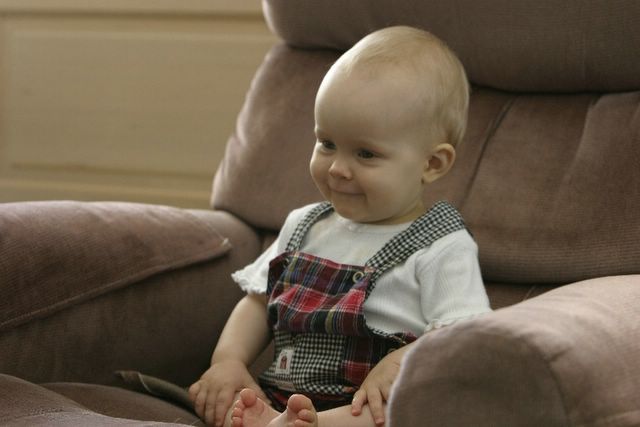

Even pictures, too
Yes, now there are pictures, thanks to Jeremy. (I don't think I've taken a picture in almost two months.) Exceedingly large amounts of cuteness available here.
Tuesday, June 07, 2005
We do dishes
A D1 post must be very overdue, at least according to certain relations, I'm sure. Truth is, she's changing so fast I can't pick out few enough things to blog about. In the space of a month, she learned to sit up, crawl, pull herself up, and cruise. She can say about half a dozen words that I can make out--her favorite being "all done!" which she now believes will cause a termination of whatever activity she is getting tired of, including a two-hour car ride. She is learning to feed herself with a spoon, a skill which was progressing quite well until her ability to scoop the food up overran her ability to keep it on the spoon. She is convinced that if she can find her hat she will get to go outside.
Next to going outside, though, her favorite new activity is doing the dishes. This started from, I confess, the basest of parental motives--I wanted to keep her quiet so I could finish the job. But it's working very well. She has figured out that the activity involves transferring dishes from the counter into the sink, so she sets herself to this task while I wash and load the dishwasher. Naturally I have to make sure that only lightweight, non-breakable dishes are within reach. We are also learning that one does not put any stray food items one finds in the dirty dishes into one's mouth.
I'm not so naive to assume that she will always come racing from her play giggling with glee when I announce it's time to do the dishes, but I do have hopes that she'll view it as a normal and not-unpleasant part of life. In the meantime, I enjoy doing the dishes a lot more with company. And I'm a lot more consistent in doing them right after the meal since I know she'll be disappointed if I don't.
Next to going outside, though, her favorite new activity is doing the dishes. This started from, I confess, the basest of parental motives--I wanted to keep her quiet so I could finish the job. But it's working very well. She has figured out that the activity involves transferring dishes from the counter into the sink, so she sets herself to this task while I wash and load the dishwasher. Naturally I have to make sure that only lightweight, non-breakable dishes are within reach. We are also learning that one does not put any stray food items one finds in the dirty dishes into one's mouth.
I'm not so naive to assume that she will always come racing from her play giggling with glee when I announce it's time to do the dishes, but I do have hopes that she'll view it as a normal and not-unpleasant part of life. In the meantime, I enjoy doing the dishes a lot more with company. And I'm a lot more consistent in doing them right after the meal since I know she'll be disappointed if I don't.
If our minds are so systemized, why can't we keep track of the bank papers?
So some fellow researching brains divides the human brain into two components, the Empathizing Quotient (EQ)--ability to understand and relate to other people--and the Systemizing Quotient (SQ)--ability to understand and analyze systems--and observes that on average women score higher on EQ and men score higher on SQ. He has a test you can take to find your score and the type of brain you have.
DOB and I both score average on EQ for our sex, and above average on SQ, which makes DOB's brain very "male" according to the chart and my brain balanced (so take that, all you who have thought I was mentally unbalanced). We both scored high on SQ for opposite reasons, though, with DOB's score due to his intuitive understanding of things like maps and insistence on knowing the technical specifications of everything he buys, while mine was due to wanting to know what everything is called and how it works. Neither skill seems to be helping us in keeping the desk organized.
The research ultimately relates to autism, though, with the theory being that autism-spectrum disorders are characterized by a high SQ with a lack of EQ. The researcher notes that there should be a corollary disorder of someone with a high EQ but lack of SQ, but says there is no clinical term for such a condition.
Well, they may not know what to call it in the UK, or in clinics, but out here, we call it blonde.
DOB and I both score average on EQ for our sex, and above average on SQ, which makes DOB's brain very "male" according to the chart and my brain balanced (so take that, all you who have thought I was mentally unbalanced). We both scored high on SQ for opposite reasons, though, with DOB's score due to his intuitive understanding of things like maps and insistence on knowing the technical specifications of everything he buys, while mine was due to wanting to know what everything is called and how it works. Neither skill seems to be helping us in keeping the desk organized.
The research ultimately relates to autism, though, with the theory being that autism-spectrum disorders are characterized by a high SQ with a lack of EQ. The researcher notes that there should be a corollary disorder of someone with a high EQ but lack of SQ, but says there is no clinical term for such a condition.
Well, they may not know what to call it in the UK, or in clinics, but out here, we call it blonde.
Monday, June 06, 2005
Hmmm . . .
Happened to click on a random link off someone's bloglist today and discovered . . . another Duke! Not only that, but he is a (a) Protestant Christian; (b) Conservative Republican; (c) Lives in the Cincinnati area; and (d) is endorsing the same candidate among the four or five running for a hotly contested Congressional seat as DOB is.
Have I stumbled across DOB's alter ego or something? The one that actually has time to comment on politics?
The only thing is, this guy has been married for five years, not almost-two. And the evidence is pretty strong that DOB couldn't have been maintaining another wife for that long. (Or if he was, she must be exceedingly patient and unsuspicious.) So it must just be an uncanny coincidence.
Have I stumbled across DOB's alter ego or something? The one that actually has time to comment on politics?
The only thing is, this guy has been married for five years, not almost-two. And the evidence is pretty strong that DOB couldn't have been maintaining another wife for that long. (Or if he was, she must be exceedingly patient and unsuspicious.) So it must just be an uncanny coincidence.
Here I Stand
Because my feet are on little plastic posts. The life of Luther in Lego. Includes throwing inkwell at devil.
Thursday, June 02, 2005
A follow-up
I have told DOB in the past that I do not recall ever personally being spanked. DOB mentioned this to my younger brother, Toolboy, when we were visiting my family last month.
Toolboy rolled his eyes. "Oh, I remember you being spanked. Mostly for beating up on me."
Hmmm. Notwithstanding Jeremy's analysis, I don't know that these spankings did much to convince me of the evils of violence. (Nor, as far as I can tell, did they do much to reinforce it.) What caused my violent side to gradually decline was discovering far greater talents of moral persuasion and argument. What put a stop to it altogether was when Toolboy grew eight inches taller than me and doubled my body weight.
I'm not sure what the moral of that is.
Toolboy rolled his eyes. "Oh, I remember you being spanked. Mostly for beating up on me."
Hmmm. Notwithstanding Jeremy's analysis, I don't know that these spankings did much to convince me of the evils of violence. (Nor, as far as I can tell, did they do much to reinforce it.) What caused my violent side to gradually decline was discovering far greater talents of moral persuasion and argument. What put a stop to it altogether was when Toolboy grew eight inches taller than me and doubled my body weight.
I'm not sure what the moral of that is.
Wednesday, June 01, 2005
Teaching about violence
The vast majority of arguments I have heard against spanking boil down to one thing: if you use force against children, they will learn to be violent.
But the last time I checked, false imprisonment and taking of property were considered violent acts just as much as battery was. So is medical treatment to which one does not personally consent. I suppose the subconscious thought is that children can hit their parents, but they can't forcibly restrain or vaccinate them. But surely if receiving violence will build a violent temperament, it does not matter whether the child has the immediate power to act in precisely the same way as the violence he observes.
Unless you are willing to forgo all forms of discipline, which are by nature coercive, as well as all medical treatment and perhaps even locks on the doors, until your child willingly consents to them, I don't see how you can raise a child without resorting to force in some degree. And if that is so, then it becomes clear that there is no particular reason to arbitrarily cut out one of many forms of force, but more difficultly a matter of figuring out which forms and degrees of force are appropriate under which circumstance for which child.
The whole violence-is-evil argument might make more sense if I really believed violence was always evil. But I don't. A soldier in a just war; a peace officer enforcing just laws; people acting in defense of self or others against unjustified violence--all of these are properly entitled to use force within certain limits. If what I want my children to learn, instead of that violence is evil, is that force is something to be very carefully used under very limited circumstances by people with the proper authority, then there is no reason why they should not see that modeled in my treatment of them.
But the last time I checked, false imprisonment and taking of property were considered violent acts just as much as battery was. So is medical treatment to which one does not personally consent. I suppose the subconscious thought is that children can hit their parents, but they can't forcibly restrain or vaccinate them. But surely if receiving violence will build a violent temperament, it does not matter whether the child has the immediate power to act in precisely the same way as the violence he observes.
Unless you are willing to forgo all forms of discipline, which are by nature coercive, as well as all medical treatment and perhaps even locks on the doors, until your child willingly consents to them, I don't see how you can raise a child without resorting to force in some degree. And if that is so, then it becomes clear that there is no particular reason to arbitrarily cut out one of many forms of force, but more difficultly a matter of figuring out which forms and degrees of force are appropriate under which circumstance for which child.
The whole violence-is-evil argument might make more sense if I really believed violence was always evil. But I don't. A soldier in a just war; a peace officer enforcing just laws; people acting in defense of self or others against unjustified violence--all of these are properly entitled to use force within certain limits. If what I want my children to learn, instead of that violence is evil, is that force is something to be very carefully used under very limited circumstances by people with the proper authority, then there is no reason why they should not see that modeled in my treatment of them.
Subscribe to:
Posts (Atom)