Saturday, September 10, 2022

A Few More Books

 We are midway through a jury trial which is the culmination of four years' hard labor, most of it solo while DOB was recovering even though litigation is not my preference. Despite the disjunction, it all seems to be coming together. And DOB is noticing that his strength and stamina are even notably improved from the trial we did in April. Mine, alas, has not changed and regardless a multi-week jury trial is a grueling physical and mental marathon.

So I am not attempting any new projects nor many very ambitious books. I did finally finish one called The Lords of Easy Money by Christopher Leonard. It was not a cheerful book, being about the policies of the Federal Reserve over the past two decades. It takes a full book to translate financial gibberish into moderately understandable terms and I am going to try to sum it up in a few sentences. Without conspiracy theories or using the ever-amorphous capitalism whipping boy, it pointed out how the Federal Reserve, acting from no worse motive than an earnest desire to be useful, or at the least to appear to be useful, has taken it upon itself to always take action to ensure continued economic growth. Unfortunately, the only tool it has at its disposal for promoting that growth is, in one form or another, lending money it just created to the people and institutions who are already the richest, creating incentives for them to purchase riskier and riskier debt, and then bailing those same people out when those risks do in fact occur. The result has been economic growth that is highly inequitable, largely illusory, and completely unsustainable.  And it has gone on and on and compounded regardless of administration or economic ideology, because they are not elected and very few people can even get their heads around what they are doing. 

I also gave a try at podcasts, which are all the rage, but I find that I do not like listening to people just talk, not even people whose blogs I enjoy on topics I am interested in. However, SOME people have created podcasts that are in fact audiobooks. I have never been much into audiobooks, but the house is intermittently quiet enough these days that an audiobook is not bad, and coupled with a peaceful building game relistening to Jane Austen is a highly relaxing activity. Even though I must now acknowledge with some chagrin I am almost certainly older than any of the living mothers.  

The first one I did was Mansfield Park. Emma is notorious for being a heroine Austen thought nobody but herself would much like, but I always suspect in Fanny she set herself the challenge of writing a heroine she didn't much like. She is quiet, docile, feminine, almost completely passive, everything that ought to make her dull as dishwater. Except she is not. The reader has the uncomfortable feeling of growing in appreciation of Fanny parallel to the villain, Henry Crawford. (And Crawford is perhaps Austen's least redeemable villain.) On the things that actually matter to her, she is bedrock. And Austen upends--before the genre had really gotten going--the romance novel convention of a charming rogue tamed by the love of a good woman. It could have been done, she acknowledges, but she will not sacrifice Fanny to the cause. Crawford is not willing to exert any effort to redeem himself, so he deserves no help from any other quarter. 

Then I did Sense and Sensibility. The dichotomy between Eleanor's sense and Marianne's sensibility is of course a commonplace, but I could not help noticing that Lucy Steele shows us there is another end of the spectrum. Eleanor is actually the golden mean--she has sense, yes, but also genuine feelings. She just knows when feelings should be expressed and when concealed. But Lucy Steele is all calculation; has no genuine feelings at all for anyone else, simply acts always and inevitably to what will advance her own self-interest. 

Another thing that is simply lovely in Sense and Sensibility is the warm and genuine friendship between Eleanor and Colonel Brandon, which exists before there is much hope of their ever being related, which never gives rise in either of them (though occasionally speculated upon by their friends) to any expectation of romance, but is simply two people who quite like and respect each other. Even in books where there are reasonably congenial brothers in law, none of them are really friends--Elizabeth and Mr. Bingley, say, are not what anyone could call friends. He never confides in her and she never seeks him out. I am sure in later years they have pleasant enough dinner parties and Christmases but I doubt they ever recommend books to each other. 

Also I cannot help but think that if I were Mrs. Dashwood and widowed at 40 I might have made a move for Colonel Brandon myself. 

Saturday, July 16, 2022

A Slight Apocalypse

 Every once in a while, a long time after everyone else, I get around to something and Have Thoughts on it. 

This time it was *Dune*, which I decided to give a try since it's considered iconic and I do like some science fiction and it seemed better than making myself sit through any of *Star Trek*. (OK, so I really only like *obscure* science fiction. *Babylon 5* forever!) 

Perhaps it is just now being the mother of teenage boys, but I feel like the teenage-boy-protagonist-will-save-the-world thing is way overdone. With apologies to Deux and Dash, who are quite decent human beings, really, here are the responses you would *actually* get if you asked a teenage boy to save the world: 

  • "Does the world really have to be saved? Couldn't we just skip it this time?"
  • "I saved the world *last* week. It's Andromeda's turn to save the world."
  • "Mmmppphh."
  • "I have to finish fighting this boss first."
  • "Oh right, I forgot. Save the world. Will do."
  • "I would, but I'm leaving right now. Maybe when I get back."
Finally, in exasperation, one would lay into them with a store of accumulated righteous indignation, only to have them say, "I already did it!"

Repeat weekly, which is how often world-ending scenarios come up in science fiction anyway.

However, it's not just the having of a teen hero. After all, the Codex Alera books have a teenage hero saving the world, and they're delightful. Mostly, I think it's just that Paul is such a thoroughly dislikable person. Cold, detached, unrealistically competent, followed by unreasonably adoring fans and worst of all, he's boring. I would not want to be his mother. Whereas I would be quite proud to be Tavi's mother. He's warm, curious, funny, he makes mistakes and has to deal with them, and just all round feels like an actual human being. 

I think the clincher for me is when Paul is proposing to the Emperor's daughter and his common-law tribal wife is like, "Oh, Paul, you don't have to worry about me, I won't get in the way of your galactic ambitions." Even though *their child was just killed by the Emperor's forces*. Kitai would have throat-punched Tavi if he had even thought about something like that. And he would have known he deserved it. 

Then again, maybe I'm just too old for this, and I will go back to cheering on Thursday Next and Precious Ramotswe. 

Thursday, May 12, 2022

A Few of the Books

Dame never really adapted to regular school, and deals with a lot of chronic pain and fatigue. Last February she was missing so many days from not feeling well that we decided to let her come back home. This is equal parts delightful and exhausting for me, as I missed homeschooling very much but also don't have a lot to give after work (and Dame is not a person who prefers to work alone, so not much is done before I arrive home.)

What we do is about equal parts Ambleside Online (currently roughly based on Year 7) and um, let's call it unschooling but it's mostly Youtube videos and her designing her own fantasy universe in luxuriant detail. Deux also still enjoys fantasy worldbuilding (the "world in his head" has been a major presence in our life since he was very small indeed) only while Dame is aimed towards books in the end Deux builds RPGs, which we cannot possibly play as fast as he designs them. 

Although Deux is doing Running Start, his classes have still been entirely online and they do not appear to absorb much of his time (I assume he is passing when he gives me the parental permission sheet to sign up for the next quarter), so he and Dame have plenty of time for intense arguments about the logistics of their respective worlds and magical universes. Deux has the edge in physics and chemistry, but Dame probably knows more about habitats and zoology. Regardless, the discussion is always lively. 

For assigned school we are reading about the Middle Ages. The really long readings we tend to listen to on Librivox while we play video games. This is not a very impressive scholastic habit, but it keeps us going. And we are reading Ivanhoe (which I have never actually finished before), and Mark Twain's Personal Recollections of Joan of Arc and In Freedom's Cause this way. We tried Idylls of the King but the readers just didn't quite make epic poetry easy to follow, so I'm reading that one aloud, along with Molecules by Theodore Gray, Eric Sloane's Weather Book, and Julius Caesar in which we take parts. There are also a goodly number of books she reads on her own, one of which is a Chaucer adaptation while I am tackling the (translated) whole thing. I can't believe it's taken me this long to try Chaucer, he's really quite hilarious and snarky. 

I also do some reading of books I might like to try for the future. Next year I want to tweak her science to give maximum support to worldbuilding, so I am looking for books on anatomy (especially comparative animal anatomy), ecology and habitats. We already have The Way We Work by David Macaulay to get us started on anatomy. I read The Hidden Life of Trees  by Peter Wohlleben and absolutely loved it, but was a little saddened that it was (naturally) so strongly skewed to the species in his native Central European forest, where Douglas fir is an ill-adapted stranger. So now I am looking at a North American focused book called Forest Walking but it annoys me just a tad because it (reasonably enough) has a North American co-writer and I always find the way people interject things from the cowriter to be odd. But content-wise it is probably more what I am looking for, there's a great deal about things we might see on a walk around the neighborhood. 

Wednesday, May 04, 2022

It Has Been Too Long

Somebody (perhaps Lewis Carroll?) advised that one should never begin a letter with an apology for how long it had taken to write back, and I suppose the same should apply to blog posts. I took an actual Day Off this week, an extremely rare event, and even though I spent a pretty large part of it scrubbing the kitchen which was sustaining several new ecosystems, I took some time to sit about long enough to remember that I needed to hunt up photos for Duchess' graduation slideshow. And the only place I really have photos is on here.

I have always figured that one of my glaring failures as a mother would be a lack of photos for the graduation slideshow (since graduation classes at Duchess' and Dash's school generally consist of 4-6 seniors, everyone gets star billing), but I was pleased to discover I was able to supply quite a respectable number even before she turned 13 and started keeping her own. Of course, most of them have Deux in them but they are quite tolerant of each other these days. 

I don't know if other people find this about growing older, but I realize that I don't feel my life stretching behind me as a sequential thing. Myself as a 12 year old scrappy know-it-all and myself as a 25 year old new mother or a 36 year old trying to juggle everything are all still here and the people and the worlds of those times do not stretch out behind me in receding distance. They are like the blog posts, just around the corner. I could step into them at any time; I might go into a room and find my mother and grandfather deep in a friendly argument, or step into the back yard and find a troupe of little Ducklings constructing a monument to unspeakable chaos out of scrap lumber. I could, but somehow I don't. 

Instead, the former Ducklings remain distressingly tall (Duchess is the only one who is shorter than me, and likely to remain so at this point) and disconcertingly independent. Somehow, as attested by the datestamps on the blog posts, eighteen years of parenthood are behind me, and Duchess is about to graduate and start her first job and college, Deux is in Running Start (at which he needs absolutely no parental guidance whatsoever but fortunately he does still appreciate parents who will play a round of Magic: the Gathering), and the twins (Dot now prefers Dame, but Dash will always be Dash) will enter high school in the fall. I feel less prepared for parenting than I did at the beginning when the first panic of having a small human in care hit me--and yet somehow, incontrovertibly, we have made it this far. 

I never did get much better at the things I was bad at (I still have boxes and boxes in the garage of Miscellaneous Things I Didn't Have The Patience to Put Away). I have faced many challenges I never expected and given up on many things that were important. There were quite a lot of things I never got to until it was too late. We never did music lessons, or sports, or make beautiful nature journals with watercolors. We did much fewer read-alouds and much more screen time than I would have believed. But I still think--hope--I managed to hold onto everything that was truly essential. 

I spent a lot more of these past seven years working than I ever wanted. I can't get that time back and it hurts every time I think of it, though it was what was necessary. But I made quite a lot of good soup, and we still had a backyard (however overgrown) and books were at least about the place and everyone learned to hate bad grammar, verbal ambiguity, and Christmas songs before Thanksgiving. And DOB is doing better, mentally and physically, than he has in many years and is finally able to return to work. 

A fair portion of my work is estate planning and so I sit down with a lot of elderly people--often their children are older than I am--and they talk about their lives and families, and sometimes it's beautiful and sometimes it's heartbreaking. In the end, not a lot matters. Not the type of diapers or the dietary plan or (within reason) the type of discipline. If your children are honest and reasonably responsible and still on speaking terms with you, you have done about as well as anyone can hope for and been luckier than many. 

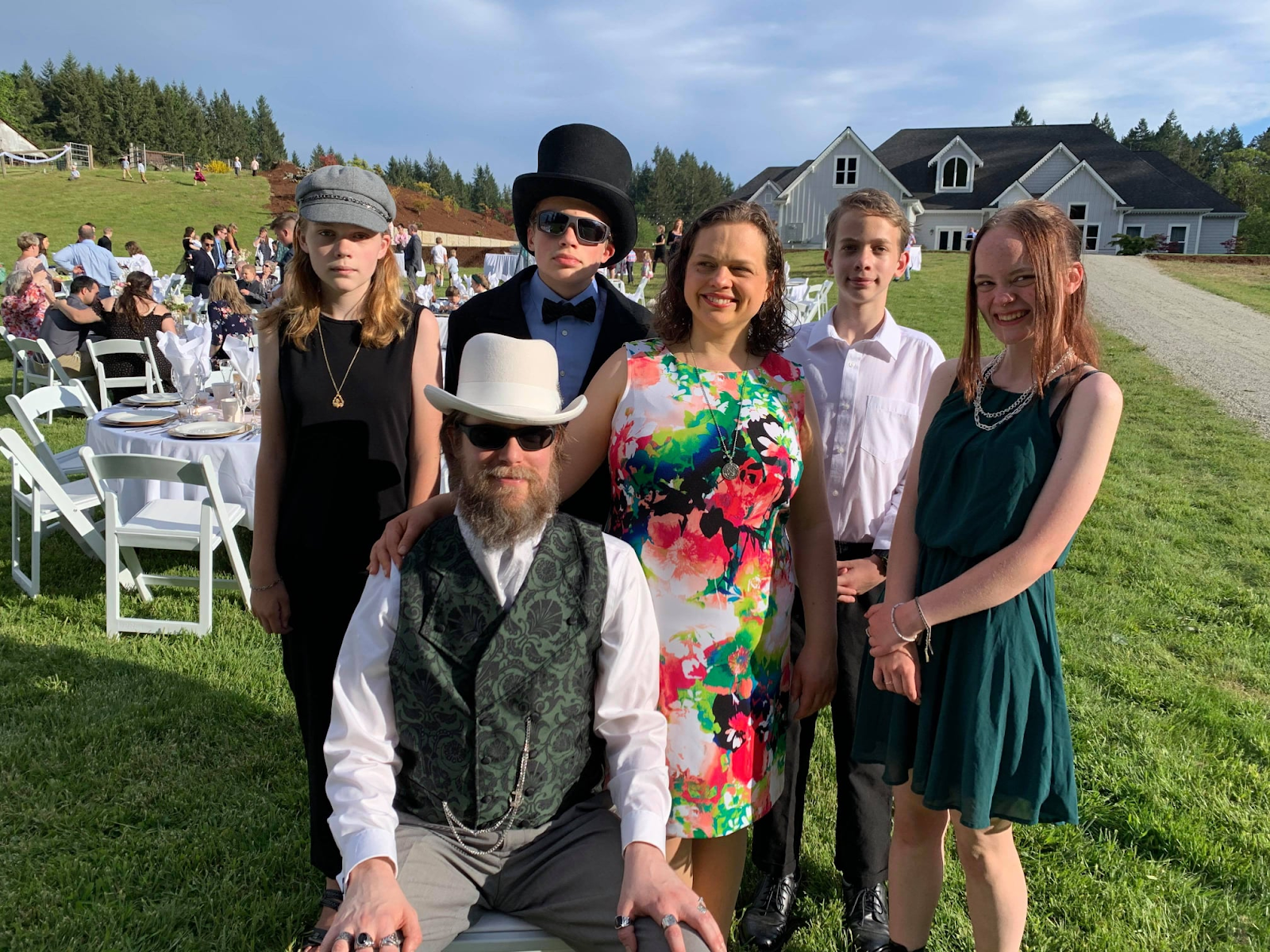
And since this is a good place for my pictures, here is one. It's actually a year old (from my oldest niece's wedding--I now have three married neiphlings and two great-neiphlings), so add an inch to Deux and three to Dash, but otherwise it's pretty on target .


Saturday, March 13, 2021

Protecting Dissent

The consequences of freedom of speech when a global platform is within the reach of just about anyone seem to have gotten a little overwhelming lately. On the one hand, it's true that freedom of speech is a political right, and therefore is not intrinsically infringed by the choices of a private entity. On the other hand, it's equally true that political rights do not thrive when they cease to represent the values of a society. 

And it is difficult to remember just how unnatural the concept of freedom of speech is. The natural human instinct is for consensus, for harmony, and for shunning if not blotting out people who disagree, a practice that was undoubtedly in place long before the Pharaohs started scratching out engravings to their disfavored predecessors. 

Even though it's my job to have people disagree with me, I still hate it every time. Still get sick to my stomach when I see that new round of pleadings come in, still get annoyed when a malicious tenant has managed to cajole a public interest attorney to dragging out an eviction to the damage of everyone around them.

At the same time, I know that this is absolutely necessary. That without that adverse position, I would get sloppy and cut corners, no matter how much I tried not to. There's no substitute for someone actually getting in the ring against you to keep you honest and careful.

And dissent in every setting has that same function. A recent book by Charlan Nemeth, In Defense of Troublemakers, points out that dissent improves thought processes and decision making--even when it is 100% wrong. It's not just that dissent is valuable because it might be right--it's because even when it's wrong, facing up to it causes us to dig deeper, consider more angles, probe underlying reasons and causes, and ultimately come to a better decision. It's because welcoming even stupid dissenters makes it more likely we'll get to hear from wise ones.

So while I certainly understand the difference between government censorship and the content choices of a private organization, I also think it's worth speaking up and fighting for freedom of speech as a social value, not just a constitutional right. That it's worth preserving the voice of the cranks, the ignorant, the prejudiced, and that one guy who has questions about line 48 in the budget just as the meeting was about to adjourn for doughnuts. Because freedom of speech is hard. It's not natural. It takes practice. And it's how we keep learning. 

Friday, December 20, 2019

Here We Go A-Wandering

It is one of our most treasured if ill-conceived traditions that we always do a Real Tree, and if humanly possible, cut it from a u-cut farm. Now that DOB is not really up to the trek, I usually pick the kids up from school on a day in mid-December and we go straight to the nearest farm to pick one before dark. We are very quick in our selection. (Is this tree short enough to reach the top? Is it right here? Then it is good.) And last year I finally learned how I had been cutting trees wrong my entire life so now the cutting down is quick, too.

Unfortunately this year obtaining a tree was delayed a week or more past our usual late date because of the repair work still being done on the house from the pipe leak that happened in August. The back room was finally finished, though, and I had Toolboy scheduled to come help me set up the new couch later in the afternoon, so I figured we could squeeze it in yesterday.

It was inconvenient but not surprising that the window to get the tree coincided with the commencement of a three-day storm of torrential downpours. It was surprising that the tree farm was already closed and since I still refuse to get a smart phone as long as my 14-year-old flip phone keeps working, I had no backup plan for finding or checking if another one was open. (To be perfectly honest, even my flip phone was dead, which is why I don't really want to bother with a smart phone.)

So the kids (Duchess, Dot and Dash--Deux had been coming down with something and elected to stay home) insisted that we needed to go try to find another farm. The only one whose location I was certain of was about half an hour drive away through the busiest roads in the county at rush hour in the downpour. Duchess was driving and insisted she keep driving. I told them we might arrive just to find it closed for the day or the year, but they all wanted to go anyway. We could always give up and go to Lowe's on the way back.

In due course we did arrive, and amazingly enough it was still open (we were the last customers of the day) and they were immediately overcome with its size and majesty, as it was about a square mile of Christmas trees. We drove out to the section with our preferred species, forded a small river that had formed in the downpour, and cut down our selected tree.

It was then I realized that, relying on the Christmas tree farm to provide the service, we had failed to bring anything to tie the tree to the top of the car. But first we had to get it back to the office, which was about a half a mile hike back through the downpour and dusk. So I told Dash to pick up the short end of the tree and we headed off while Duchess drove back to the office. Dot accompanied us out of an overpowering desire to commune with nature.

We had made it most of the way back and watched Duchess drive past us en route to the office when Duchess came driving back, with twine to tie the tree to the top of the car. (It was at this moment that it occurred to me that we could have done this in the first place.) So we did, although not very well, and at this point after fifteen minutes walk in the downpour I had finally noticed that I was missing my hat, which I had actually knitted myself during a triennial fit of craftiness, out of green and brown variegated yarn.

So Duchess, Dash and I decided to drive all the way back to the place we cut the tree before it got darker to try to find the hat, while Dot elected to continue on to the office and commune with hot cocoa. We found the spot again easily enough (the small river was handy in location) but it now occurred to me that a knit hat made of green and brown variegated yarn looks exactly like the ground in a Christmas tree farm in a downpour at dusk in December. Happily we did find it.

Somewhere in here the tree fell most of the way off the car and I had to try to tie it on again, but it was still threatening to careen off the side the whole time.

Then it seemed to Duchess that rather than turning around what with stumps and streams and all she would be better off to keep driving on the assumption that the roads in the tree farm would loop back around to the office sooner or later. They did, but by the time we made it back Dot had finished her trip to the office, drunk an entire cup of hot cocoa, and come back out to stand in the rain and wonder what was taking us so long.

Then everyone else who wanted cocoa got it and the man still waiting for us to leave tied the tree on extremely securely and I insisted on driving home. We were all soaked to the skin and I still had a sectional couch to set up.

Everyone thought it was the best tree expedition ever.

Saturday, November 10, 2018

Crime and Punishment

It was not an easy read. It was a good read, but definitely not easy, as much for the emotional intensity and theme as the usual Russian habit of giving everyone 6 different names and swapping them in and out at random. (Next time I start a Russian novel, I need to create a cast of characters to accompany me, because half the time I'm not sure who's talking.)

I probably shouldn't have been reading The Secret History of Moscow at the same time, which, although an intriguing book, made for altogether too much Russianness. We are all doomed, so let's drink more vodka.

Still, it was amazing and the scene in which he confesses to Sonia and she sees right through his confusion and misery and inability to repent to the suffering human at the core without the slightest hint of excusing wrongdoing is one of the most amazing things I've ever read.

It was a tough summer (and fall) and not much good for heavy reading. DOB had another new and different health challenge, some new diagnosis and a lot of uncertainty still.

So I'm certainly not going to finish out my Back to the Classics challenge, but I can surely fit in one more before the end of the year. And the dice roller says it will be Jude the Obscure, another one I suspect may be hard to get through.

That only brings me to 5 (having abandoned Swiss Family Robinson), so I'm going to throw in Orthodoxy as a bonus because I can certainly do that before the end of the year and at least make half my goal.

Considering the year it's been, that's pretty good, and maybe I can do the other half next year. 


Sunday, June 03, 2018

The Scarlet Letter

It's always risky revisiting a book that one remembers from childhood or adolescence; it may live up to your memories, it may not, or you may realize that you completely missed the point as a young person.

Fortunately The Scarlet Letter and I both survived the test of the re-read. It's a wonderful book, and although I certainly didn't get the full depth of the book at 15 (or now, likely enough) neither was I entirely uncomprehending.

Interestingly, I think the version I read back then must have omitted the author's preface explaining his finding of the story-sparking manuscript, which is largely a personal polemic on the character-sapping influences of a safe government job. I found it pretty entertaining now, from the position of the envious but proud private sector.

Simultaneously, I was reading Games People Play, one of the iconic works popularizing psychology from the 1960s. There was certainly some overlap--you could certainly see Chillingsworth playing a game of Now I've Got You, You Son of a Bitch disguised as I'm Only Trying to Help You while Dimmesdale plays Kick Me. They both get what they want from the relationship. (Psychology from the 60s still sounds far more judgmental than modern works. It's fascinating to begin to feel the distance from an era that I am old enough to think of as not that long ago.)

Psychology is intriguing, but literature will always tell us more, because it shows people from the inside. Only through literature can we get to be Hester Prynne and Arthur Dimmesdale and Roger Chillingsworth and maybe even little Pearl. On the whole, I liked Dimmesdale the least this time around, for his moral cowardice. But then, at least he turned it to kindness which is better than many in his situation do. It was really Pearl he wronged the most, and perhaps that is why Hawthorne shows her the most healed by his final confession.

Also reading: The Queen's Thief series, a re-read after I got Deux hooked on it. Just an absolutely fantastic series. And The Phoenix Guards, a fantasy swashbuckler. And The Genius of Birds, which is intriguing but will not tell me a question I have been wanting to know, whether anyone has found out if rabbits can do math. And I picked up Rachel Ray by Anthony Trollope at the library booksale, and it promises very well indeed. Summer Reading Challenge at the library has started and I intend to at least get the 10-hour book bag, although the 100-hour t-shirt may be a bit ambitious for me.

Next on the classics challenge roll:  Crime and Punishment. Gulp. I'm almost as intimidated by that one as by the Aeneid, but here goes.

Saturday, May 12, 2018

Laws and Customs

Washington, in the true populist tradition reflecting its heritage, has elected, non-partisan judges. At our recent Law Day celebration, the Supreme Court justice who spoke referred to it as a right we "would never surrender, and never exercise."

He was speaking more generally of the ignorance the voting public has of judicial candidates, but the quote was even truer than that, as is evidenced every time a judge retires. At least in our county, the judges never retire at a time that they could be replaced by an election. Thus, the governor must appoint a replacement.

There is an extensive vetting process through the governor's office, various attorney associations conduct panel discussions and make recommendations, and someone is chosen. None of the process is open to the public at large. At some point the new judge will have to run for re-election, but they will do so with the full weight of incumbency behind them. Since I have been practicing in the county, no one has upset a sitting judge or even run a serious campaign against one.

At the most recent judicial panel, someone raised the question of whether this practice was good or whether it thwarted the public participation that was intended to be part of the process. To my surprise, not a single candidate of four criticized it. They all spoke in favor of the current practices as weeding out unqualified candidates, as there is simply no way for the public to assess whether someone would be a good judge--the qualities that make for a good candidate are likely to be the opposite of those that would make for a good judge.

In the last round, the candidate that was chosen had already been serving as court commissioner for over a year. She'd been hired originally by the judges and the local bar had had ample chance to observe her in the courtroom and determine whether she reviewed her materials, kept up on the law, kept control of the courtroom, and rendered fair decisions. It was a good pick.

What is fascinating to me is how, in a time that is still strongly driven by the desire to rip out old inequities and replace customs with great systems of logic, yet customs grow up anyway. Logical systems are never quite enough to go on with.


The Fall of Arthur and other books

This was nice and short. I didn't realize that about two-thirds of the book was appendices and explanatory material which I do not feel obligated to read as they were not written in the twentieth century. I did enjoy the one explaining in a bit more detail the rules and history of the Anglo-Saxon alliterative verse that Tolkien employs. It's far more intricate than initially appears, and it creates a weighty style, all sharp edges and hard corners, that is excellent for epics and marvelously atmospheric.

Not on the list, but maybe I'll pretend it was if I don't get them all in, I read Phantastes by George MacDonald. I think I read it once as a teenager; it was well worth revisiting.

Completely not on the classics list, I'm reading The E*myth Enterprise in an effort to get my head around running the business side of the law practice, something that has become acutely necessary in the past few months. (I can make no sense of the title by the book, by the way, and it annoys me greatly and sounds very cheesy. Still, there are some good ideas in there.)

I'm thinking about ditching Swiss Family Robinson. We've completely gotten away from reading out loud, and I think the book is partly responsible. It's just too implausible and too preachy. Also, it's part of the literature assignments the kids either have or will get to at school, so I feel no urgency to read it. I'm not a quitter, but when a piece of the thing is blocking the whole thing from occurring, it's time to ditch the piece. I'm not sure what to choose next, though. Nothing has lived up to Lord of the Rings, unsurprisingly. I want to read The Sword in the Stone, but I'm thinking of doing a traditional Arthur telling first.

And for my next trick--I rolled a 9, so it will be The Scarlet Letter. I'm really looking forward to it.

Saturday, April 07, 2018

Next Challenge

Time for a new book. I'm kind of behind if I'm going to finish all twelve this year, but my first two selections were long, so maybe I will pick up the pace.

And the next selection is:

2. The Fall of Arthur

Time for some more epic poetry. I think I'll find Tolkien more readable than Virgil, though.

In other undertakings, we are ssllllooowwwwllllyyyy reading through Swiss Family Robinson. The twins seem to be enjoying it, but even Dash asked, "Why does the father know how to do everything?" It seems to work best if we envision it as an RPG in which the players are all overpowered, the GM is far too indulgent, and everyone always rolls a 20.

Friday, April 06, 2018

Kristin Lavransdatter, Mistress of Husaby and The Cross

Alas, I finished it. Now I have to move back to reality. I didn't die of the black plague, though, so that's good.

And I find it impossible to sum up. So much life. 

The middle novel details the years of prosperity--Kristin, finding herself mistress of a large noble estate in near-ruins thanks to Erlend's ineptitude, rises to the occasion in between birthing seven sons. Erlend wanders in and out, making himself a decent name as a border governor. They fight and make up, have another baby, fight and make up again.

Undset is incredibly good at showing the tangle of feelings, of desire and resentment, of missed cues and muddled responsibilities of a struggling marriage. Kristin's steadiness that gives her the ability to rise to being mistress of a noble estate--CEO, doctor, brewer, farmer, head of charity and society woman all rolled into one--goes along with a steady resentment that Erlend cannot be more like her even steadier father (though of course she never could love the steady man her father picked out). Only by tossing aside reality can she enjoy a bit of peace with Erlend, and that never happens for long once she has the heritage of her sons to worry about.

After a particularly nasty argument, Erlend has a brief revenge affair, which ends even worse than expected--it turns out he's been leading a plan which, had it gone well, would have marked him down as a hero of his country, but thanks to his idiocy the plan is discovered and he is tried for treason. 

Always at their best in a crisis, Kristin and Erlend reconcile and thanks to the tireless labor of Simon, Kristin's former betrothed (and now brother-in-law), Erlend is freed, but at the cost of land and titles. The family retires to Kristin's childhood home, which is her own property.

In the final book is the fallout. The fragile reconciliation falls to pieces again. Life goes on until it doesn't any more.  At the end, one son takes over the farm, the others scatter to seek their fortune or the cloister, and the widowed Kristin enters a convent. 

I saw one review commenting on the centrality of motherhood to the book and that is a major theme--and as I first read the book over a decade ago, when I was still in the baby stage and now revisit it as my children are entering their teens, I feel it with her--the constant loss, the fears, the joys that are only remembered in retrospect and the pain that is better than joy--even more than the first time through. 

But another theme that comes through is the journey of the soul to God--that all the things of life, the worries, the triumphs, the joys and sorrows--are not the main thing that most people think, nor distractions as people trying to be devout think, but the way through which God himself shows himself to us. On her way to the convent, Kristin gets sidetracked by a crowd of little boys: "And when the moment came that she had longed for all through her journey, when she stood below the cross on Feginsbrekka and looked down on Nidaros, it came not so that she could collect her thoughts for prayer or meditation. All the bells of the town burst forth at that moment to ring to Vespers, and the boys all talked together, wanting to point out all that was before her--"

Or, to put my favorite song with my favorite book, 

"Every heart--every heart to love will come/But as a refugee."

Here is my review from 2006. I will read this book again. Maybe in 2030. 

Friday, March 23, 2018

Kristin Lavransdatter, Book 1: The Bridal Wreath

I don't know if it's cheating or overachieving to smuggle in a trilogy as one selection in the Back to the Classics challenge, but I will do it for Kristin Lavransdatter. If I had a cabin and a pot of soup and Kristin Lavransdatter, then that would be the best vacation ever.

So it is hard with such a book to sum up or critique. I don't read Kristin Lavransdatter; I move temporarily to 14th-century Norway. All the people and the life are so real, shown without romanticism or grotesqueness. The people live in their own world, unastonished at their own life for all its strangeness to us, yet still as real and ordinary as anyone you might know.

The Bridal Wreath gives a bit of background on Kristin's family and then tells her growing up years, from early childhood to her wedding. Kristin's doting and devout father, Lavrans, is a well-respected knight and a skilled farm manager; her mother is dedicated but melancholy, weighed down by many infant losses and a dark secret. In due course Kristin's father arranges her a good marriage to Simon, a perfectly suitable but rather boring young man, but Kristin is not so sure. At Simon's suggestion, she spends a year at a convent school in the south to get a bit more worldliness. What she gets instead is an introduction to Erlend, a dashing, higher-ranking, and not all that young man who is, in more than just Lavrans' estimation, not good for much but seducing women.

Well, things go much as one would expect in any century. Or again, not, because no one here is a stock character. Even the minor characters, like the saintly Brother Edvin, or the enigmatic witch Lady Aashild, are very real. The actions of a 28 year old who seduces a naive 16-year-old girl out of a convent to a brothel are as despicable to the medieval Norwegians as they would be if it started in an online chat room today; yet Erlend does genuinely care for Kristin, after his own weak-willed fashion. And while Kristin learns to lie and sneak and is as utterly short-sighted in romance as a teenage girl can be, yet her devotion has its own greatness and beauty to it.

Two quotes from either end of the influences in Kristin's life:

Lady Aashild: "In this world they call him a fool who wastes his heritage that he may make merry in the days of his youth. As to that, each man may deem as he lists. But that man only do I call a fool and a very dolt who rues his bargain after it is made . . . "

Brother Edvin: "There is no man nor woman, Kristin, who does not love and fear God, but 'tis because our hearts are divided twixt love of God and fear of the devil and fondness for the world and the flesh, that we are unhappy in life and death. For if a man had not a yearning after God and God's being, he would thrive in hell, and 'twould be we alone who would not understand that there he had gotten what he desired."

Saturday, March 03, 2018

Next Selection

And now it's time for me to roll again, hoping for a selection a little easier to get through than the last . . .

First I rolled a 5. But that's Swiss Family Robinson, which is a family read aloud (and we've already started). At the rate we've been having read-alouds, it's going to take us all year to get through.

So a re-roll for a personal read, and it's a 4: Kristin Lavransdatter. Which may take me as long to get through as the Aeneid, but if memory serves me right it's a process I will enjoy far more.

The Aeneid

Well, I made it. And it took me the first two months of the year, but it was probably the toughest read for me. I'm not very quick with epic poetry. I keep getting lost and having to backtrack or give up on following entirely. Especially during the battle parts (which was basically the last six books) I was pretty much like Alice reading Jabberwocky, "Well, somebody killed something, that's certain."

I did get a bit of an aha about why ancient poetry is so dang tedious, though. Even though the Aeneid was written, it still takes its form from the oral tradition. And if you really wanted to remember an important war and all the important generals and battles, without writing it down, you'd want to turn it into poetry. Now that we have catalogs and history books we can skip all the lists and focus on the action, but if we didn't no doubt we'd still be recounting the Civil War in a similar fashion.

The parts with the gods and goddesses interfering were more interesting. Basically it all came down to a feud between Juno and Venus; Venus who apparently was Aeneas' mother by a mortal, and Juno who favored Carthage and thus had it in for the Romans before they could even become Romans. (In one scene Venus gets her immortal husband, Vulcan, to make Aeneas special armor. It never explains how Vulcan came to be so chill with the situation, but I suppose they'd had a few decades to work it out and maybe he figured that it was part of the price of being married to the goddess of love. On the other hand, you never see Juno acting so calmly about Jove's sidelines.)

Really the interference of the deities was depressing. If they decide you need to do something, or die conveniently, or turn on your nearest and dearest, then do it you will, whether they have to resort to persuasion, trickery, or brute force.

In other reading, I also re-read the entire Anne series while sick with the flu. It was strange to revisit after quite a while. I don't think I'd read it since the children were tiny. It was a little depressing to realize that after a lifetime of expecting I would grow up to be Anne as a mother with a house as well-ordered and supportive as Ingleside, the best I could hope to emulate was the Merediths, domestic chaos and nearly absent parents with the kids mysteriously turning out pretty OK anyway.

Read The Clockwork Boys (it's by Ursula Vernon, but her adult novel pen name which I can't remember off the top of my head) and was very annoyed to realize Bookworm had tricked me into reading the first book when the sequels weren't out read. Read The Goose Girl by Shannon Hale and liked it once I got into it. Feel like I read some other fun fantasy, but can't remember what right now.

Oh, and I got a whole lot of graphic novels for the kids that were new to us, most of which I didn't read because I find graphic novels hard to follow, but I also realized that there are two sequels to Hereville out now, and was very very happy to read those.

Saturday, February 03, 2018

A Series of Unfortunate Events

We cleared the strep--actually Dash and I never got it, thanks be--just in time for a round of flu. This time I'm pretty sure Dash did get it, though he stoutly denied it. Still, when a 9 year old boy heads straight for the couch after school without even a sideways glance at Roblox, something is definitely up.

Deux had a really bad time of it and I didn't feel so well myself, especially since I had a contested hearing and a bar dinner the second day of it. (I did win, though. The flu seems to be lucky for me.) Then we had a much-needed weekend to be sick in, and the internet went out all weekend (for reasons entirely unrelated to the reason the internet had been going out at the office every day all month) and the washing machine broke and the dogs dug a new hole under the fence.

I never actually missed a day of work, but I was dragging pretty badly by the end of the week. So Friday morning DOB offered to get the kids to school--he had morning court--and let me sleep in a few hours. Sound in theory, but Duchess in a moment of exuberance knocked Dash's glasses and a lens fell out and then DOB, in an attempt to superglue it back in the frame, had superglued himself to the glasses. So I got up and got DOB unstuck so he could get to court. At this point the lens was in but so covered with superglue that it was useless for its intended purpose, so we took it out and I tried to put in the lens from his old, even more broken frames. I managed it without supergluing myself, but still got the lens hopelessly covered in glue.

After about an hour of applied nail polish remover, we finally had a functional if not very beautiful pair of glasses for Dash and I took him to school and gave up on the resting and went in to work.

We are mostly better now, although Dash is napping again. And a friend who came over to give an opinion on the dog fence issue has suggested an approach that will allow us to avoid buying more fencing and take advantage of something we do very well--grow eight-foot tall Himalayan blackberries with thorns like razors. If a few of these are relocated to the fence, it should be ample deterrent for digging and if a few of them take root (and they always take root) the solution should be self-perpetuating.

Sara Jones maintains that February is the evil month, but I am sincerely hoping that February can have a bit of mercy on us.

Sunday, January 07, 2018

Loathsome Diseases

This time of year people are posting uplifting things on Facebook about magically ridding themselves of negativity and drama to face the new year which will bring nothing but uplift and positivity.

What I find is that the new year is laying in wait with its own new store of negativity and drama. Such as, say, two-thirds of the family getting strep, some of them in places one did not even know it was possible to have strep.

Apparently Duchess actually had it last month and I didn't notice. Well, she did complain her throat was pretty sore a time or two, and one day she felt bad enough to stay home from school, which is pretty bad in her world, but I made her some tea and figured it would pass. I tend to take after my grandmother who reputedly refused to believe my father was particularly ill when, as it turned out later, he actually had polio. She made him go out and play anyways. The doctor later told her he probably was all the better for it.

Then DOB was ill, but DOB generally is ill this time of year to some degree or another. His sinuses do not care for winter.

Then Deux and Dot had the first week of school derailed by mysterious and unpleasant symptoms. Unfortunately things reached a head just when I was scheduled to take Rocketboy to a endoscopy appointment in the early morning, so DOB had the fun of dealing with miserable children overnight and emergency doctor appointments in the middle of court while I was semi-guiltily enjoying a ferry ride all by myself and order-in ramen and other such luxuries of city life with Rocketboy and Bookworm.

But I returned home with lots of books from Bookworm and everybody has medicines and ointments and after a few days are starting to feel semi-human. And I cleaned the fridge.

Chesterton on Being a Lawyer

" . . . we should always be much more inclined to trust a solicitor who did not talk about conveyancing over the nuts and wine. What we really desire of any man conducting any business that the full force of an ordinary man should be put into that particular study. We do not desire that the full force of that study should be put into an ordinary man. We do not in the least wish that our particular law-suit should pour its energy into our barrister's games with his children, or rides on his bicycle, or meditations on the morning star. But we do, as a matter of fact, desire that his games with his children, and his rides on his bicycle, and his meditations on the morning star should pour something of their energy into our law-suit. We do desire that if he has gained any especial lung development from the bicycle, or any bright and pleasing metaphors from the morning star, that they should be placed at our disposal in that particular forensic controversy. In a word, we are very glad that he is an ordinary man, since that may help him to be an exceptional lawyer."

~G. K. Chesterton, Heretics

Wednesday, January 03, 2018

First Post

Well, it is the new year and I have started the Aeneid. Turns out I actually really like it. It's not as gruesome as the Iliad, and not as discursive as the Odyssey, and spends less time on the sunrises.

It's still about the Trojan War, though. Apparently it took several centuries for everyone to get over that one. Only this is the story of the losers. History may be written by the winners, but poetry is written for the losers--or in this case, the current winners who want to remind everyone how they started out as losers.

Besides Troy, the thing these books have in common that is almost impossible for modern retellings to recreate is the sense of the gods as the primary actors. Moderns may try, but we cannot entirely take it seriously; we think they must just be putting it on and revert to cynicism as soon as they are offstage. But it's not really about the adventures of Aeneas; it's about Juno's and Venus's plans to check and counter-check each other and poor mortals just get caught in the middle.

Maybe they were wrong, but then, maybe they had a better appreciation of their limits than we do.

I'm not great at reading epic poetry--there are a lot of allusions to other places and people that I certainly don't want to bother digging out, so then I start skimming and then I realized I missed a key clue as to who is talking or doing something because they will use three or four names for the same entity. Poetic variation is overrated.

In other readings, I'm still finishing up Heretics by Chesterton and Napoleon's Buttons by Penny Le Couteur. And I just got Dirk Gently's Holistic Detective Agency in from the library, but I haven't started it yet.

Sunday, December 31, 2017

Back to the Classics Challenge #1: The Aeneid

Taking a cue from Uglemor, I will be rolling a D12 to determine the sequence of my Back to the Classics Challenge reads.

(Exception will be Swiss Family Robinson, which I will start whenever we finish Watership Down.)

And my first roll is . . . 11. I'll be starting with the Aeneid.

Well, get the tough stuff out of the way first has always been my motto. Starting tomorrow.